
[中] 何殷震的作品
He Zhen (Chinese: 何震, c. 1884 – c. 1920) was an early 20th century Chinese feminist and anarchist. Born He Ban in Yizheng, Jiangsu, she married the noted scholar Liu Shipei in 1903 and went with him to Tokyo. She then took the name He Zhen (He "Thunderclap") but signed her published writings He-Yin Zhen (何殷震) in order to include her mother's maiden name. She published a number of strong attacks in anarchist journals on male social power which argued that society could not be free without the liberation of women. Her essay "On The Question Of Women's Liberation," which appeared in Tianyi in 1907, opens by declaring that "for thousands of years, the world has been dominated by the rule of man. This rule is marked by class distinctions over which men—and men only—exert proprietary rights. To rectify the wrongs, we must first abolish the rule of men and introduce equality among human beings, which means that the world must belong equally to men and women. The goal of equality cannot be achieved except through women's liberation." "On The Question Of Women's Labor," published in Tianyi in July 1907, traces the exploitation of women's labor from the times starting with the "well field system" of ancient China, especially decrying the tragedies of prostitution, female infanticide, and concubinage of recent times. "Economic Revolution And Women's Revolution" "On The Revenge Of Women," asks the women of her country: "has it occurred to you that men are our archenemy?" "On Feminist Antimilitarism," and "The Feminist Manifesto" were also powerful indictments of male social power.
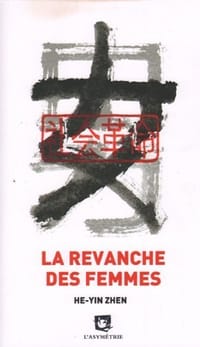
He Zhen (Chinese: 何震, c. 1884 – c. 1920) was an early 20th century Chinese feminist and anarchist. Born He Ban in Yizheng, Jiangsu, she married the noted scholar Liu Shipei in 1903 and went with him to Tokyo. She then took the name He Zhen (He "Thunderclap") but signed her published writings He-Yin Zhen (何殷震) in order to include her mother's maiden name. She published a number of strong attacks in anarchist journals on male social power which argued that society could not be free without the liberation of women. Her essay "On The Question Of Women's Liberation," which appeared in Tianyi in 1907, opens by declaring that "for thousands of years, the world has been dominated by the rule of man. This rule is marked by class distinctions over which men—and men only—exert proprietary rights. To rectify the wrongs, we must first abolish the rule of men and introduce equality among human beings, which means that the world must belong equally to men and women. The goal of equality cannot be achieved except through women's liberation." "On The Question Of Women's Labor," published in Tianyi in July 1907, traces the exploitation of women's labor from the times starting with the "well field system" of ancient China, especially decrying the tragedies of prostitution, female infanticide, and concubinage of recent times. "Economic Revolution And Women's Revolution" "On The Revenge Of Women," asks the women of her country: "has it occurred to you that men are our archenemy?" "On Feminist Antimilitarism," and "The Feminist Manifesto" were also powerful indictments of male social power.