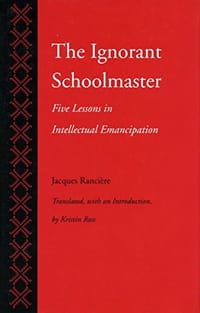
The Ignorant Schoolmaster

Jacques Rancière

出版时间

1991-07-01

ISBN

9780804719698

评分

★★★★★
书籍介绍
Review 'An extremely provocative, original, and engaging book, it raises questions of great relevance and urgency about the process of cultural selection and canonization.'Denis Hollier, Yale UniversityIgnorant Schoolmaster In The Ignorant Schoolmaster, Rancière uses the historical figure of Joseph Jacotot as a way of discussing human nature, education, pedagogy, ignorance, intelligence, and emancipation. These ideas have profound implications on the nature of schooling and research, and the role that teachers and scholars play. Contents [hide] 1 Joseph Jacotot (1770-1840) 2 Explication 3 Emancipation 4 Ignorance 5 Intelligence 6 Will 7 Language [edit] Joseph Jacotot (1770-1840) Jacotot was a French instructor who taught subjects as far-ranging as French, literature, mathematics, ideology and law (p. 1). He had a profound realization one time when he had to teach a group of Flemish students French. Since he didn’t know Flemish himself, he had the challenge of teaching these students French. [edit] Explication The conventional view of the teacher’s (or master’s, as Rancière calls it), is to “explicate”. But Jacotot noticed that his Flemish students were able to learn French without any explication from him. He had given them a bilingual text of Télémaque; using that, his students were able to eventually under French grammar and spelling, using a text that was aimed for adults, and not “simplified” for school children. Jacotot (or maybe Rancière?) was inspired to ask: Were schoolmaster’s explications superfluous? (p. 4) Rancière believes that explication stultifies learning by short-circuiting the journey that the student is able to make. Teachers who rely on explication inadvertently creates a “veil of ignorance” (p. 6) what the student is expected to learn, thus creating a world of superior (i.e. the master, the explicator) and inferior (i.e. the student, the ignorant). But Rancière believes that all people are capable of learning without explication because they have all acquired their mother tongues without explication (p. 5, 10). They learn, imitate, and correct themselves, and universally, all children will grow up to understand their parents without every spent one day in school. Why do we presume this intelligence goes away? [edit] Emancipation Rancière distinguishes between two human traits: intelligence and will. In Jacotot’s classroom, there are two wills (the students’ and Jacotot’s) and two intelligences (the students’ and the book’s). Students may need to follow the teacher’s will, who guides them towards the subject. But stultification occurs when the students’ intelligences are linked with the teacher’s, when they have to rely on the schoolmaster to explain what they have learned. The opposite of stultification is, therefore, emancipation. But who emancipates? Once again, conventionally, it is the scholar, the philosopher, the wise, the learned, the Teachers College doctoral student. But Rancière believes that the only way to emancipate is when an intelligence obeys only itself even if its will obeys another’s will (p. 13). In reality, universal teaching has existed since the beginning of the world, alongside all the explicative methods...Everyone has done this experiment a thousand times in life, and yet it has never occurred to someone to say to someone else: I’ve learned many things without explanations, I think that you can too... (p. 16)In Jacotot’s class, the students learned using their own methods, not his. And in the end, they learned French, and they have done so using the oldest method in the world: universal teaching. [edit] Ignorance Rancière argues that the “Socratic Method” is a perfected form of stultification, where the role of the Master is to interrogate (demand speech) and verify that intelligence is done with attention (p. 29). Even if these pedagogies are aimed at “empowering” the student, it is still done so after the master has verified it. Thus, it is still the master’s method, not the student’s. The ignorant schoolmaster does not verify what the student has found, only that the student has searched (p. 31). This means that anyone, including illiterate parents, can teach their children how to read and write. For example, they can question whether they pronounce the same word each time in the same way, or hide it under their hand and ask the student what is under it. This is true not only for re [edit] Intelligence Most people become stultified because they believe in their inferiority (p. 39). And superior minds can only be superior if they can make everyone else inferior. Thus we never break out of that circle, not matter how generous our intentions may be. The word intelligence is often understood as a number, or variable, that describes different people’s capacities to comprehend complex ideas or solve logic problems. But Rancière believes that everyone has the same intelligence (p. 50). He argues that a statement like “Bob is smarter because he produces better work
AI导读
核心看点
  • 提出智力平等论,挑战传统教育等级。
  • 借雅克托历史案例,探讨解放与无知。
  • 批判讲解神话,主张学生自主探究。
适合谁读
  • 对教育哲学与政治哲学感兴趣的读者。
  • 关注社会平等与个体解放的思考者。
  • 希望反思传统师生关系的教师群体。
读前提醒
  • 文风奇特,叙述者与角色常混淆。
  • 英译本质量参差,建议参考中译本。
  • 论证简练,需结合现象学背景深读。
读者共识
  • 观点激进且具启发性,但论证稍弱。
  • 重读时令人深思,具有震撼力。
  • 需长时间消化,非快餐式读物。

本导读基于书籍简介、目录、原文摘录、短评和书评生成,不等同于全文精读。

精彩摘录
  • "它的现实性,就在于它的离奇"
  • "它不仅形成了对教师的依赖,更建立了对各智力不平等的深信。"
  • "所有智力皆为平等。......而是说智力在其各种展现中都是同样的。......去行使自己的知性能力,......让自己被他人看作、并也将他人看作恒久劳动的探究者和艺术家,......"
  • "是讲解人需要无能者,而不是后者需要前者。正是讲解人塑造了这样的无能者。......讲解与其是教学活动,更是教育的神话。"
  • "所有的句子,以及写出句子的所有智力,本来都只有一种。所谓理解,始终不过是翻译,是给出一篇文字的对应,而毫不直呈其后的理性。"
  • "教师要做的,就是将一个智力限制在一个任意的循环里,让它只有靠自己才能走出去。"
  • "普遍教育法:先学某件事,再将它联系到其余一切,并依从这条原则:所有人都有同等的智力。"
  • "解放,即所有人都能建立作为人的尊严、认识自身的知性能力并决定其用处。"
用户评论
這個忘記標註了——說實話Ross的翻譯不是沒有問題的
why individual must be defended against society
"But never forget that you have seen results of a much superior order to those you have obtained and to which you will be reduced. Make use, then, of intellectual emancipation for the benefit of yourselves and your children. Help the poor. But for your country, confine yourselves to making subalterns and academic citizens."
所有从业于与教育和观众有关行业的人士必读
She is concerned solely with knowledge more, with knowing what she did not yet know. What she lacks, what the pupil will always lack, unless she becomes a schoolmistress herself, is knowledge of ignorance- a knowledge of the exact distance separating knowledge from ignorance.
得到一些啓發。
齐智论
反省自己在教书时的愚笨化行为与傲慢心理也感到厌恶。想起柏拉图的学习回忆说,上界的智慧生来便扎根于每个人心中,只不过灵魂在人间蒙上了尘埃,发现真理便是去蔽与回忆的过程,重返纯真。亦想起史铁生在《我与地坛》文末失落地发问,若没有稀罕的智慧与悟性,不幸的人如何得到救赎?但现在我想这也许是悲天悯人却又大可不必的文人心理,智慧之光平等地悬挂在所有人之上,救赎之路虽窄却不排斥任何愿意踏上此程的人。(论证确实有武断之处,但瑕不掩瑜
收藏