
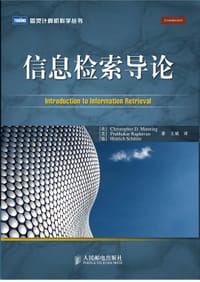
书籍介绍
翻开这本书,读者最先感受到的不是高深莫测,而是一种把搜索引擎
作者简介
Christopher D. Manning,1989年毕业于澳大利亚国立大学,1995年获斯坦福大学语言学博士学位,曾先后在卡内基-梅隆大学、悉尼大学教授语言学,1999年起任斯坦福大学计算机科学和语言学副教授,其主要研究方向是统计自然语言处理、信息提取与表示,以及文本理解和文本挖掘等。
Prabhakar Raghavan,毕业于印度理工学院,后获加州大学伯克利分校计算机科学博士学位,自2005年起担任Yahoo!研究中心负责人,同时也是斯坦福大学计算机科学系顾问教授。其主要研究方向是文本及Web数据挖掘、组合优化、随机算法等,此前曾任Verity公司CTO,在IBM研究院担任过管理工作。
Hinrich Schütze,斯坦福大学博士,现任斯图加特大学自然语言处理研究所理论计算语言学主任。他在美国硅谷工作过多年,曾担任过Enkata公司首席科学家。
AI导读
核心看点
- 系统讲解搜索引擎核心技术,涵盖倒排索引与文档分类。
- 结合机器学习与数值计算,实现理论与实战的完美结合。
- 由斯坦福及硅谷专家联袂撰写,兼具学术深度与业界水准。
读者共识
- 作为IR领域权威教材,逻辑清晰,适合建立知识体系。
- 内容全面但部分细节描述不够深入,需配合其他资料。
- 英文原版口碑极佳,中文版翻译质量总体受到认可。
精彩摘录
- "The term “unstructured data” refers to datawhich does not have clear, semantically overt, easy-for-a-computer structure."
- "A proximity operator is a way of specifying that two terms in a query must occur close to each other in a document, where closeness may be measured by limiting the allowed number of intervening words or by reference to a structural unit such as a sentence or paragraph."
- "INTERSECTWITHSKIPS(p1, p2) 1 answer ← h i 2 while p1 = NIL and p2 = NIL 3 do if docID(p1) = docID(p2) 4 then ADD(answer, docID(p1)) 5 p1 ← next(p1) 6 p2 ← next(p2) 7 else if docID(p1) < docID(p2) 8 then if hasSkip(p1) and (docID(skip(p1)) ≤ docID(p2)) 9 then while hasSkip(p1) and (docID(skip(p1)) ≤ "
- "(1) How many keys are we likely to have? (2) Is the number likely to remain static, or change a lot, and in the case of changes, are we likely to only have new keys inserted, or to also have some keys in the dictionary be deleted? (3) What are the relative frequencies with which various keys will be"
- "1. Retain the first letter of the term. 2. Change all occurrences of the following letters to ’0’ (zero): ’A’, E’, ’I’, ’O’, ’U’, ’H’, ’W’, ’Y’. 3. Change letters to digits as follows: B, F, P, V to 1. C, G, J, K, Q, S, X, Z to 2. D,T to 3. L to 4. M, N to 5. R to 6. 4. Repeatedly remove one out of e"
- "BSBINDEXCONSTRUCTION() 1 n ← 0 2 while (all documents have not been processed) 3 do n ← n +1 4 block ← PARSENEXTBLOCK() 5 BSBI-INVERT(block) 6 WRITEBLOCKTODISK(block, fn) 7 MERGEBLOCKS( f1, . . . , fn; fmerged)"
- "SPIMI-INVERT(token_stream) 1 output_ f ile = NEWFILE() 2 dictionary = NEWHASH() 3 while (free memory available) 4 do token ← next(token_stream) 5 if term(token) / ∈ dictionary 6 then postings_list = ADDTODICTIONARY(dictionary, term(token)) 7 else postings_list = GETPOSTINGSLIST(dictionary, term(toke"
- "VBENCODENUMBER(n) 1 bytes ← hi 2 while true 3 do PREPEND(bytes, n mod 128) 4 if n < 128 5 then BREAK 6 n ← n div 128 7 bytes[LENGTH(bytes)] += 128 8 return bytes VBENCODE(numbers) 1 bytestream ← hi 2 for each n ∈ numbers 3 do bytes ← VBENCODENUMBER(n) 4 bytestream ← EXTEND(bytestream, bytes) 5 retur"
目录
用户评论
很多地方描述得不清晰,缺乏细节和条理。
没人送又买不起,只有借了!
:
G252.7/6432
考试是刷书的绝佳机会,呵呵。这本书太基础了,想搞信息检索的人还是先学学机器学习吧
以后看...
很棒的IR入门书,深入浅出,简洁明了又有一定趣味性。
研一的时候跟的一个导师做的方向不太喜欢,后来就跟了另一个导师,好处是不管我做什么了,坏处是我也不知道要做啥,然后当时有师兄做数挖这块,就跟着选了这块。中间有次在学校碰到了研一的导师,导师问我现在做的是什么,是搜索那块的工作吗,我说勉强算是吧(其实差别挺大的),就买了这本书,一直也没看,因为感觉用不上。研究生毕业之后做了一年多的风控,感觉风控太简单后来又转去做了一年多推荐,最后无意间找工作去了熊厂,居然无意间做起了搜索,真是人生如梦兜兜转转又回到了原点的位置。再说回这本书,这真是一本神奇的书,从算法到工程实践无所不包,理论上如果代码能力足够好,可以仅仅依靠这本书,不使用任何三方工具(类似es这种),就能从零到一的做一个可用的搜索引擎。确实是很棒的书,现在读的缺点就是有点老了吧。
读过一章也算读过。。。
全面可靠。(后来的修订版没啥太大变化)2012-10-19京东购
NLP借IR发力,可翻读。



下载
收藏