
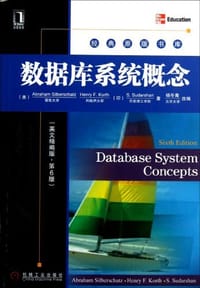
书籍介绍
这本书最常被提及的,不是它讲得多全,而是它讲得有多"浅"。作为面向国内本科课堂改编的精编版,它刻意砍去了大量高级主题,换来概念清晰、图示直观、翻译难得的阅读体验,非科班读者也能啃下来。但正因如此,它也引发争议:不少读者抱怨被"精编""本科版"字样误导,删去的背景与扩展恰恰是理解"为什么这样设计"的关键,读起来容易变成零散知识点的拼凑。它适合想要建立数据库整体认知、搞清"数据为何是核心"的初学者,却不太能满足想直接上手开发的读者。换言之,它是一扇带你走进数据库世界的门,而不是让你精通的门。
作者简介
Abraham Silberchatz 于纽约州立大学石溪分校获得博士学位,现为耶鲁大学计算机科学Sidney J. Weinberg教授,计算机科学系主任,曾任贝尔实验室信息科学研究中心副主任。他是ACM Fellow 和 IEEE Fellow,曾获得IEEE Taylor L.Booth 教育奖、 ACM Karl V.Karlstrom 杰出教育者奖、ACM SIGMOD 贡献奖和IEEE 计算机学会杰出论文奖。他的研究兴趣包括操作系统、数据库系统、存储系统、网络管理和分布式系统。
Henry F. Korth 于普林斯顿大学获得博士学位,现为利哈伊大学计算机科学与工程系Weiseman教授,曾任贝尔实验室数据库原理研究中心主任。他是ACM Fellow 和 IEEE Fellow,是VLDB 10年贡献奖的获得者。他的研究兴趣包括为现代计算架构(多核、多线程、多级缓存)设计的数据库算法、基于Web的大型数据仓储、实时数据库系统和并行系统。
S. Sudarshan 于威斯康星大学麦迪逊分校获得博士学位,现为印度理工学院计算机科学与工程系教授,曾为贝尔实验室数据库研究组技术人员。他的研究兴趣包括查询处理和优化、关系数据和图结构数据的关键字查询,以及构建和测试数据库应用系统的工具。
AI导读
核心看点
- 数据库领域殿堂级经典,夯实理论基础
- 内容简练直观,以图示示例替代形式化证明
- 涵盖SQL查询、索引原理及大数据分析前沿
读者共识
- 经典必读,适合自学,讲解细致且通俗易懂
- 理论性强,对直接开发帮助有限,重在内功
- 翻译质量尚可,但部分表述略显饶舌不够精炼
精彩摘录
- "作为对商业数据计算机化管理的响应,在20世纪60年代出现了最早的数据库系统。现代的数据库应用包括有非常复杂的全球型企业。跟现代的数据库应用相比,那些早期的应用是相对简单的。 所有的数据库应用,不管老的还是新的,都共享重要的公共元素。比如**数据库应用的核心不是执行某种计算的程序,而是数据本身**。今天,一些最有价值的公司之所以有价值,不是因为它们的有形资产,而是因为它们拥有的信息。想象一下,如果一个银行没有了账户和客户数据,一个社交网站丢失了用户之间的联系,则这些公司的价值就全部丧失了。 使用数据库来管理数据集有以下特点: - 数据非常有价值; - 数据量相对较大; - 数据会同时被许多用户和"
- "Although we refer to the SQL language as a “query language,” it can domuch more than just query a database. It can define the structure of the data, modify data in the database, and specify security constraints. IBM developed the original version of SQL, originally called Sequel, as part of the Syst"
- "When writing queries, you should be careful to include appropriate where clause conditions. If you omit the where clause condition in the preceding SQL query, it would output the Cartesian product, which could be a huge relation. For the example instructor relation in Figure 2.1 and the example teac"
- "The from clause by itself defines a Cartesian product of the relations listed in the clause. It is defined formally in terms of set theory, but is perhaps best understood as an iterative process that generates tuples for the result relation of the from clause. for each tuple t1 in relation r1 for ea"
- "In contrast, the attributes name and building appear in only one of the relations, and therefore do not need to be prefixed by the relation name. • The select clause is used to list the attributes desired in the result of a query. • The from clause is a list of the relations to be accessed in the ev"
- "In preceding chapters,we have emphasized the higher-level models of a database. For example, at the conceptual or logical level, we viewed the database, in the relational model, as a collection of tables. Indeed, the logical model of the database is the correct level for database users to focus on. "
- "3.7 Aggregate Functions Aggregate functions are functions that take a collection (a set or multiset) of values as input and return a single value. SQL offers five built-in aggregate functions: • Average: avg • Minimum: min • Maximum: max • Total: sum • Count: count If we do want to eliminate duplica"
- "3.7.3 The Having Clause 1. As was the case for queries without aggregation, the from clause is first evaluated to get a relation. 2. If a where clause is present, the predicate in the where clause is applied on the result relation of the from clause. 3. Tuples satisfying the where predicate are then"




下载
收藏