
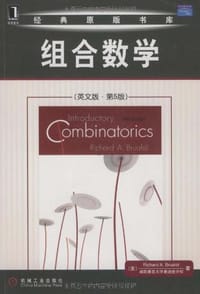
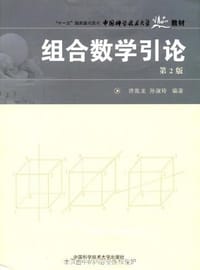
书籍介绍
作为计算机与数学专业的经典入门教材,这本书最大的争议恰恰也是它的价值所在:它把组合数学讲得足够浅,浅到非数学系读者也能
作者简介
Richard A.Brualdi美国威斯康星大学麦迪逊分校数学系教授(现已退休),曾任该系主任多年。他的研究方向包括组合数学、图论、线性代数和矩阵理论.编码理论等。Brualdi教授的学术活动非常丰富,担任过多种学术期刊的主编。2000年由于“在组合数学研究中所做出的杰出终身成就”而获得组合数学及其应用学会颁发的欧拉奖章。
AI导读
核心看点
- 本书系统涵盖排列组合、鸽巢原理、容斥原理、生成函数及递归关系等组合数学核心基础理论,提供严谨的数学定义与公式推导,如排列数P(n,r)与组合数C(n,r)的计算法则,适合构建扎实的离散数学知识体系。
- 书中包含大量经典数学问题案例,如国际象棋棋盘覆盖、幻方构造、四色问题、36军官问题及最短路径问题等,通过具体实例引导读者理解抽象概念,但部分复杂定理证明被省略,侧重直观理解而非深度理论探究。
- 作为经典原版教材的影印版,本书保留了英文原版的所有技术细节与算法描述,包括排列组合生成算法及Nim博弈等内容,但需注意其英文版性质,对于中文阅读能力有限或依赖中文译本辅助理解的读者可能存在阅读障碍。
读者共识
- 读者普遍认为这是一本经典的组合数学教材,内容全面且基础扎实,但中文版翻译质量极差,被广泛吐槽为‘机翻’和‘歪曲题意’,严重影响了阅读体验和理解,强烈建议有能力者直接阅读英文原版。
- 多数读者反馈本书作为入门教材尚可,但部分章节过于啰嗦且缺乏深度,复杂定理证明被省略,更像是一本科普性质的介绍书,对于希望深入钻研组合数学理论或算法实现的读者来说,内容深度不足。
- 尽管存在翻译和深度问题,仍有部分读者认为其基础部分讲解详细,无需前置知识即可上手,习题具有锻炼价值,但必须警惕其不适合自学,且部分章节如博弈论内容前后不一致,需结合其他资源补充学习。
精彩摘录
- "For n and r positive integers with r <= n, P(n, r)=n*(n-1)* ……*(n-r-1)=n!/(n-r)!"
- "The number of circular r-permutations of a set of n elements is given by P(n,r)/r=n!/r(n-r)! In particular, the number of circular permutations of n elements is (n-1)!"
- "For 0 <= r <= n, P(n,r) = r!C(n,r) Hence C(n,r) = n!/r!(n-r)!"
- "For 0 <= r <= n, C(n,r)=C(n, n-r)"
- "For all integers n and k with 1 <= k <= n, C(n,k) = C(n-1,k) + C(n-1,k-1)"
- "For n >= 0 C(n,0)+C(n,1)+C(n,2)+...+C(n,n)=2^n, and the common value equals the number of subsets of an n-element set."
目录
Preface1 What Is Combinatorics? 1.1 Example: Perfect Covers of Chessboards 1.2 Example: Magic Squares 1.3 Example: The Four-Color Problem 1.4 Example: The Problem of the 36 OfFicers 1.5 Example: Shortest-Route Problem 1.6 Example: Mutually Overlapping Circles 1.7 Example: The Game of Nim 1.8 Exercises2 Permutations and Combinations 2.1 Four Basic Counting Principles 2.2 Permutations of Sets 2.3 Combinations (Subsets) of Sets 2.4 Permutations of Multisets 2.5 Combinations of Multisets 2.6 Finite Probability 2.7 Exercises3 The Pigeonhole Principle 3.1 Pigeonhole Principle: Simple Form 3.2 Pigeonhole Principle: Strong Form 3.3 A Theorem of Ramsey 3.4 Exercises4 Generating Permutations and Combinations 4.1 Generating Permutations 4.2 Inversions in Permutations 4.3 Generating Combinations 4.4 Generating r-Subsets 4.5 Partial Orders and Equivalence Relations 4.6 Exercises5 The Binomial Coefficients 5.1 Pascal's Triangle 5.2 The Binomial Theorem 5.3 Unimodality of Binomial Coefficients 5.4 The Multinomial Theorem 5.5 Newton's Binomial Theorem 5.6 More on Partially Ordered Sets 5.7 Exercises6 The Inclusion-Exclusion Principle and Applications 6.1 The Inclusion-Exclusion Principle 6.2 Combinations with Repetition 6.3 Derangements 6.4 Permutations with Forbidden Positions 6.5 Another Forbidden Position Problem 6.6 M6bius Inversion 6.7 Exercises7 Recurrence Relations and Generating Functions 7.1 Some Number Sequences 7.2 Generating Functions 7.3 Exponential Generating Functions 7.4 Solving Linear Homogeneous Recurrence Relations 7.5 Nonhomogeneous Recurrence Relations 7.6 A Geometry Example 7.7 Exercises8 Special Counting Sequences 8.1 Catalan Numbers 8.2 Difference Sequences and Stirling Numbers 8.3 Partition Numbers 8.4 A Geometric Problem 8.5 Lattice Paths and Schr6der Numbers 8.6 Exercises9 Systems of Distinct Representatives 9.1 General Problem Formulation 9.2 Existence of SDRs 9.3 Stable Marriages 9.4 Exercises10 Combinatorial .Designs 10.1 Modular Arithmetic 10.2 Block Designs 10.3 Steiner Triple Systems 10.4 Latin Squares 10.5 Exercises11 Introduction to Graph Theory 11.1 Basic Properties 11.2 Eulerian Trails 11.3 Hamilton Paths and Cycles 11.4 Bipartite Multigraphs 11.5 Trees 11.6 The Shannon Switching Game 11.7 More on Trees 11.8 Exercises12 More on Graph Theory 12.1 Chromat,ic Number 12.2 Plane and Planar Graphs 12.3 A Five-Color Theorem 12.4 Independence Number and Clique Number 12.5 Matching Number 12.6 Connectivity 12.7 Exercises13 Digraphs and Networks 13.1 Digraphs 13.2 Networks 13.3 Matchings in Bipartite Graphs Revisited 13.4 Exercises14 Polya Counting 14.1 Permutation and Symmetry Groups 14.2 Burnside's Theorem 14.3 Polya's Counting Formula 14.4 ExercisesAnswers and Hints to ExercisesBibliographyIndex
用户评论
课本飘过……
作为组合数学入门书我给五星。内容全面,也很好上手,不需要其他前导知识,大部分习题不难但有锻炼价值。
不知道数学系的同学看是什么感觉 作为非数学系的表示看着很过瘾 很久没遇到像这样能看懂的数学书了…
废话挺多的。包含了不少内容但并不深入,更像是一本科普书,而且开头提到了Nim游戏后面又没再说过博弈相关的内容。此外生成排列和组合那里的几个算法感觉略奇怪。不过这本书用来了解下组合数学的大概倒是挺合适的。
讲的相当详细,不过部分过于啰嗦。 想深入可以研读相关论文
还有一个月就摆脱这本教材了
例子非常多,稍難一點的定理就不證,too introductory




下载
收藏