
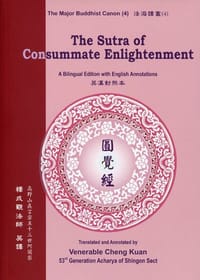
书籍介绍
The Translator’s Foreword
This Sutra is one of the most unique Scriptures among the Mahayana Sutras. Generally speaking, there are two main branches, or two Pillars, in the Mahayana Teachings: one of them is called the School of Essenceism; the other, the School of Morphism. The former deals with the Noumenon or Entelechy (i.e., the Ontology, or the fundamental reality, or “Body”) of all living beings, and as such, it is also called “Nature,” or “Quintessence,” or “Innate Nature,” or “Buddha Nature,” or “Veracious Thusness.”
The second branch of Mahayana Buddhism, the School of Morphism, is more or less the counterpart of the Essence School; for instead of dealing with Nature or Reality and so on, it treats the subject close to that of Phenomenology, in that it surveys, delineates, classifies in great detail all aspects of phenomena, especially the mental ones and those which have great bearing on the practice of Buddhism, such as the Cause, Effect, Functioning, Arising, Transformation, Mutation and Expiration of a given Dharma, or a mental activity. And as such, the Buddhist Morphism has a close affinity to the western Metaphysics and Psychology combined. Hence, it is evident that the Buddhist Morphism School could be very helpful both in the completeness of the Doctrine and in the individual practice on the Dharma. But somehow, during the evolution of Buddhism in China throughout history, the Morphism School became gradually neglected, and eventually it was reduced to all but an abstruse antiquity. Although there was some effort devoted to the “renaissance” of this school around the middle of the previous century, and there are more and more practitioners and scholars who have been paying attention to the study and exegesis of the Canonical Scriptures in this field, but much more effort would be required to make the superb knowledge of this particular school see the day of popularity as was seen in its heyday in the Tang Dynasty.
Now the present Sutra, The Sutra of Consummate Enlightenment, subsumes to the Essence School, and it is one of the most significant Sutras in Ch’an Buddhism. In the practice of Ch’an Buddhism, there are two great approaches: the Gradual Approach (or the Gradual Teaching, or Gradual School), and the Instantaneous Approach ( or the Instantaneous Teaching, or Instantaneous School), the latter of which expatiates and emphasizes “Instantaneous Enlightenment,” which could be comprehended, for western readers’ convenience, through some partial affinities that it shares with such terms as “Spontaneous Insight,” or “Epiphany.” This Consummate Enlightenment Sutra falls under the heading of the Instantaneous School. But what makes this Sutra so unique and treasurable among all other Ch’an Buddhism Scriptures is that its predominant doctrine is not just “instantaneous,” but it is “the most instantaneous of the instantaneous.” In the sphere of the Instantaneous Teachings, there could be no others that could pose as its peer. For instance, in the Sutra the Buddha says:
Virtuous Man, true Awareness of the Phantasmata shall enable one to depart from them forthwith; hence, no other Dexterous Means need to be implemented for it. And on one’s Departure from Phantasmata, straightway would one become enlightened; hence, no Gradual Approaches would ever be in need, either. (p. 20, Scroll I: Segment 2)
This could be by far the grandest, the most valiant, and the most thoroughgoing “manifesto” of Instantaneous Tenet, and as such, throughout history, it has been highly esteemed and deferentially espoused by Ch’an practitioners. Besides this prominent feature about Instantaneity, this Sutra also stresses on the absolute necessity of observing Precepts in the practice of meditation (or Ch’an) for the pursuit of Enlightenment, especially in the intensive practice in a Retreat; otherwise there will be impediments or even all sorts of adversities befalling the practitioner. And this is particularly important for present-day practitioners (who are called “latter-age Multibeings” in the Sutra), in that nowadays the situation of Buddhism, or that of religions in general, is in a “turbulent upheaval,” and so all sorts of doctrines, or even Devious Teachings (as the Buddhas has foreseen and pointed out) are rampant all over the world. Consequently, there is no guarantee that what you are being exposed to and practicing is the Right Dharma (Orthodox Buddhism), unless it palpably and definitely embodies the Buddha’s Precept in its system, without ever running athwart it in any case; otherwise, you might just waste your time and energy (and/or even money) in vain, to say the least; it is more likely that you would fall a victim to some outrageous loss or unknown malady or even possible derangement, due to your unwitting following of the Devious Teachings without the protection of the Buddha’s Precept, which is the Cornerstone and a MUST for all practices in Buddhism—in epitome, without
下载
收藏