
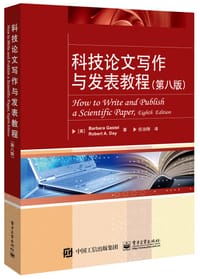
书籍介绍
这本书真正打动人的,是它反复强调一个近乎执念的观念:一篇论文只有被他人正确理解,才算真正写完。实验做得再漂亮,若不发表、若读者读不懂,就等于'树里开花无人闻'。它把'写'从科研的附属品提升为科研本身——科学家既要'做'科学,更要'写'科学。正因如此,书里对IMRAD结构、对'清晰即简洁'的坚持、对可重复性如何塑造现代论文格式的历史梳理,都带着一种近乎哲学思辨的分量。不过读者也提醒:它胜在鸟瞰全局、建立框架,却未必能手把手解决你某一章节的具体困惑。适合想快速看清科技写作全貌、尤其生物等实验学科的人,也适合被它'写出来才算数'的信念打动而鼓起投稿勇气的新手。
作者简介
芭芭拉•盖斯特尔(Barbara Gastel),医学博士,美国得克萨斯农工大学(Texas A&M University, College Station)教授,负责协调科学传播研究生课程,在AuthorAID(一个帮助科研人员写作和发表研究成果的国际项目)承担领导角色。出版的作品包括Health Writer’s Handbook,以及很多关于写作、编辑和其他论题的文章。在众多国家举办过科学写作的研讨班,20世纪80年代早期曾在北京医学院(现北京大学医学部)授课两年,为促进中国和其他发展中国家的学术交流做出重要贡献。盖斯特尔获American Medical Writers Association,Board of Editors in the Life Sciences,Council of Science Editors和Sigma Xi(Scientific Research Honor Society)的奖项和表彰。
罗伯特•戴(Robert A. Day)是美国特拉华大学(University of Delaware, Newark)英语名誉教授。长期负责American Society for Microbiology(ASM)的出版项目,并在《微生物学学报》(Journal of Bacteriology)和其他8个ASM期刊担任执行主编。戴是学术出版协会(Society for Scholarly Publishing)前主席、生物学编辑委员会(Councilof Biology Editors)前主席。举办多场科技写作的研讨和培训,其著作集中于科学写作、编辑和出版,与Nancy Sakaduski合著Scientific English: A Guide for Scientists and Other Professionals一书。
AI导读
核心看点
- 系统阐述IMRAD结构,涵盖论文写作、投稿全流程
- 强调语言简洁清晰,提供大量科研写作实用案例
- 新增ORCID、数字海报等移动互联网时代交流新进展
读者共识
- 内容全面规范,是科研新手入门写作的经典教材
- 行文简洁准确,但部分出版信息可能略显过时
- 实用性强,有助于快速建立对学术发表的整体认知
精彩摘录
- "The logic of IMRAD can be defined in question from: what question was studied? The answer is the Introduction. How was the problem studied? The answer is the Methods. What were the findings? The answer is the Results. What do these findings mean? The answer is the Discussion."
- "The goal of scientific research is publication. A scientific experiment, no matter how spectacular the results, is not completed until the results are published. The scientist must not only "do" science but must "write" science. Certainly, many scientists do not like to write. As Charles Darwin said"
- "… must provide a written document showing what he or she did, why it was done(reason or significance of the research), how it was done(method), and what was learned from it(results and discussion)."
- "Like the Occam's razor, the spirit of scientific writing is also simpleness and clarity. State your facts as simply as possible, even boldly. No one wants flowers of eloquence or literary ornaments in a research article. — R. B. McKerrow Successful scientific experimentation is the result of a clear"
- "A scientific experiment is not complete until the results have been published and understood. Publication is no more than "pressure waves" unless the published paper is understood(声音没有被人听到就相当于没有,而文章没有被别人正确理解就相当于这篇文章没有写). Too many papers fall silently in the woods. A scientist will spend months or ye"
- "Especially because of the work of Louis Pasteur, who confirmed the germ theory of disease and who developed pure-culture methods of studying microorganisms, both science and the reporting of science made great advances. … Pasteur found it necessary to describe his experiments in exquisite detail. Be"
- "What question(problem) was studied? The answer is the Introduction. How was the problem studied? The answer is the Methods. What were the findings? The answer is the Results. What do these findings mean? The answer is the Discussion."
- "An acceptable primary scientific publication must be the first disclosure containing sufficient information to enable peers: 1. to assess observations 2. to repeat experiments 3. to evaluate intellectual processes moreover, it must be susceptible to sensory perception, essentially permanent, availab"
目录
第一部分 预备知识 Some Preliminaries
第1章 科技写作内涵 What Is Scientific Writing? 2
1.1 科技写作范畴 The Scope of Scientific Writing 2
1.2 务必清晰 The Need for Clarity 2
1.3 接收信号 Receiving the Signals 3
显示全部
用户评论
结构很清楚 相关内容已阅、笔记
有一些启发,但比较零散;在这本书的鼓励下投稿了第一篇会议论文。
2019年从北大图书馆借阅;的确是科技写作方面的重要教材!从论文写作到发表、制作图表、各种类型写作、科技英语写作风格、学位论文、申请基金等等,涉及面广泛,有很多参考资料!开了眼界、增长知识,力求做到实践!
对科技论文写作发表大概要求作了介绍。适合初学者快速入门。
非常全面,当然我更期望有一本贴近国内的科技写作书籍。
如果对于论文写作发表不太了解的话,想有一个鸟瞰式的印象可以读读。但是太空泛了,学不到什么真正实用的东西,而且有点过时。真正想理解其中某一个章节,还得自己去学习。
很适合科研小白,但入门之后就太水了
龚老师,您的二手书被我捡了
电子工业出版社的其他书籍查看全部





求书
收藏