
内容简介
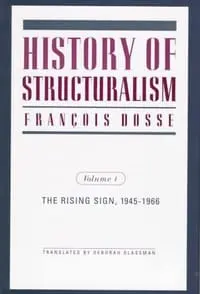
The first comprehensive history of one of the most influential intellectual movements of the twentieth century.Claude Levi-Strauss, Roland Barthes, Jacques Lacan, Louis Althusser, Jacques Derrida, and Michel Foucault -- the ideas of this group of French intellectuals who propounded structuralism and poststructuralism have had a profound impact on disciplines ranging from literary theory to sociology, from anthropology to philosophy, from history to psychoanalysis. In this long-awaited translation, History of Structuralism examines the thinkers who made up the movement, providing a fascinating elucidation of a central aspect of postwar intellectual history.Francois Dosse tells the stow of structuralism from its beginnings in postwar Paris, a city dominated by the towering figure of Jean-Paul Sartre. The work of Saussure became the point of departure for a group of younger scholars, and the outcome was not only the doom of Sartre as intellectual leader but the birth of a movement that would come to reconfigure French intellectual life and would eventually reverberate throughout the Western world.Dosse provides a readable, intelligible overall account, one that shows the interrelationship among the central currents of structuralism and situates them in context. Dosse illuminates the way developments in what are usually distinct fields came to exert such influence on each other, showing how the early structuralists paved the way for later developments and for recent discourses such as postmodernism. The cast of characters related by Dosse includes those mentioned above as well as Roman Jakobson, Julia Kristeva, Pierre Bourdieu, Gilles Deleuze, Felix Guattari, Tzvetan Todorov, andmany others. Chapters are devoted to major figures, and Dosse has done extensive interviews with the major and minor figures of the movement, furnishing an intellectual history in which historical players look back at the period.This first comprehensive history of the structuralist movement is an essential guide to a major moment in the development of twentieth-century thought, one that provides a cogent map to a dizzying array of personalities and their ideas. It will be compelling reading for those interested in philosophy, literary theory, sociology, anthropology, linguistics, and psychoanalysis."Excellent.... Dosse reminds us that not only was structuralism an intellectual event of the sixties, it was also the cultural coup d'etat that both put an end to the reign of Sartre and existentialism and inaugurated the rise of the humanities". Le Figaro"Dosse's work is exceptional in its pursuit of an honest and relevant archaeology that not only clarifies the past but offers lessons for the future". Liberation
弗朗索瓦・多斯,1972年在巴黎第八大学获得历史学士学位,1973年通过了声望极高的教师资格考试。1974年起在蓬图瓦斯高中任教。一年之后,在让・谢诺的指导下,开始攻读博士学位,主攻方向是1968年以来“年鉴学派”与媒体问题。任教于巴黎第十大学,著有《破碎的历史:走向“新史学”的“年鉴派”》和意义的帝国:人文科学的人化》等著作。为许多文化名流撰写过知识传记。
读者评论
University of Minnesota Press的其他书籍查看全部
 《Intolerable》
 《Oye Loca》
 《Spiv and the Architect》
 《Essays Critical and Clinical》
 《The Anti-Politics Machine》
 《The Coming Community》