
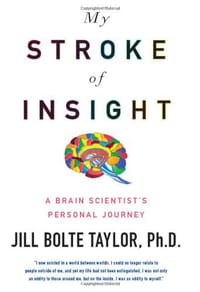
My Stroke of Insight - Jill Bolte Taylor, 吉尔·伯特·泰勒

My Stroke of Insight

Jill Bolte Taylor, 吉尔·伯特·泰勒

出版社

Viking Adult

出版时间

2008-05-14

ISBN

9780670020744

评分

★★★★★
书籍介绍
在线阅读本书 A brain scientist's journey from a debilitating stroke to full recovery becomes an inspiring exploration of human consciousness and its possibilities On the morning of December 10, 1996, Jill Bolte Taylor, a thirty-seven-year-old Harvard-trained brain scientist, experienced a massive stroke when a blood vessel exploded in the left side of her brain. A neuroanatomist by profession, she observed her own mind completely deteriorate to the point that she could not walk, talk, read, write, or recall any of her life, all within the space of four brief hours. As the damaged left side of her brain--the rational, grounded, detail- and time-oriented side--swung in and out of function, Taylor alternated between two distinct and opposite realties: the euphoric nirvana of the intuitive and kinesthetic right brain, in which she felt a sense of complete well-being and peace; and the logical, sequential left brain, which recognized Jill was having a stroke, and enabled her to seek help before she was lost completely. In My Stroke of Insight , Taylor shares her unique perspective on the brain and its capacity for recovery, and the sense of omniscient understanding she gained from this unusual and inspiring voyage out of the abyss of a wounded brain. It would take eight years for Taylor to heal completely. Because of her knowledge of how the brain works, her respect for the cells composing her human form, and most of all an amazing mother, Taylor completely repaired her mind and recalibrated her understanding of the world according to the insights gained from her right brain that morning of December 10th. Today Taylor is convinced that the stroke was the best thing that could have happened to her. It has taught her that the feeling of nirvana is never more than a mere thought away. By stepping to the right of our left brains , we can all uncover the feelings of well-being and peace that are so often sidelined by our own brain chatter. A fascinating journey into the mechanics of the human mind, My Stroke of Insight is both a valuable recovery guide for anyone touched by a brain injury, and an emotionally stirring testimony that deep internal peace truly is accessible to anyone, at any time. Questions for Jill Bolte Taylor Amazon.com: Your first reaction when you realized what was happening to your body was one you would expect: "Oh my gosh, I'm having a stroke!" Your second, though, was a little more surprising: "Wow, this is so cool!" What could be cool about a stroke? Taylor: I grew up to study the brain because I have a brother who is only 18 months older than I am. He was very different in the way he perceived experiences and then chose to behave. As a result, I became fascinated with the human brain and how it creates our perception of reality. He was eventually diagnosed with the brain disorder schizophrenia, and I dedicated my career to the postmortem investigation of the human brain in an attempt to understand, at a biological level, what are the differences between my brain and my brothers brain. On the morning of the stroke, I realized that my brain was no longer functioning like a "normal" brain and this insight into my brother's reality excited me. I was fascinated to intimately understand what it might be like on the inside for someone who would not be diagnosed as normal. Through the eyes of a curious scientist, this was an absolutely rare and fascinating experience for me to witness the breakdown of my own mind. Amazon.com: What did you learn about the brain from your stroke and your recovery that your scientific training hadn't prepared you for? Taylor: My scientific training did not teach me anything about the human spirit and the value of compassion. I had been trained as a scientist, not as a clinician. I can only hope that we are teaching our future physicians about compassion in medicine, and I know that some medical schools, including the Indiana University School of Medicine, have created a curriculum with this intention. My training as a scientist, however, did provide me with a roadmap to how the body and brain work. And although I lost my left cognitive mind that thinks in language, I retained my right hemisphere that thinks in pictures. As a result, although I could not communicate with the external world, I had an intuitive understanding about what I needed to do in order to create an environment in which the cells in my brain could be happy and healthy enough that they could regain their function. In addition, because of my training, I had an innate trust in the ability of my brain to be able to recover itself and my mother and I respected the organ by listening to it. For example, when I was tired, I allowed my brain to sleep, and when I was fresh and capable of focusing my attention, we gave me age-appropriate toys and tools with which to work. Amazon.com: Your stroke affected functions in your left brain, leaving you to what you call the "la-
AI导读
核心看点
  • 脑科学家亲历中风,用专业视角记录意识崩塌与重建过程
  • 生动对比左脑理性逻辑与右脑感性直觉的运作机制差异
  • 揭示神经可塑性原理,展示感恩与专注对康复的关键作用
适合谁读
  • 对脑科学、心理学及人类意识探索感兴趣的科普爱好者
  • 经历重大挫折或疾病,寻求心理重建与精神力量的读者
  • 希望理解左右脑分工,提升专注力与情绪管理能力的职场人
读前提醒
  • 书中部分观点将灵修体验归因于右脑,需保持批判性思维
  • 后半部分重复较多,若对神经解剖细节无兴趣可快速略读
  • 建议结合作者TED演讲阅读,体验更凝练的叙事与情感冲击
读者共识
  • 中风发作时的意识流描写极具画面感,震撼且令人动容
  • 作者顽强康复的精神令人敬佩,但部分理论总结略显武断
  • 文笔细腻流畅,虽有小确幸之嫌,但能引发对生命的深思

本导读基于书籍简介、目录、原文摘录、短评和书评生成,不等同于全文精读。

精彩摘录
  • "时间的节点不再来无影去无踪,连续的瞬间交织在一起,形成一条延伸的脉络,细胞在进化中生生不息,形成了跨越时间的桥梁。不久,细胞便找到了彼此连接、共同工作的方式,最终,你和我诞生了。"
  • "我的右脑半球总是关注此刻此地。它带着无拘无束的热情四处观望,对世俗浑不在意。它总是在笑,特别友善。与之形成鲜明对比的是我的左脑,它对细节全神贯注,严格按照时间表安排生活。它是我生活中严谨的那一面。它总是让我下巴紧绷,根据既往的经验做决策。它设定界限,并用对错或者好坏界定所有事物。哦,是的,它在做决策时会紧锁眉头。"
  • "第二章"
  • "我成功康复的另一个很基础的秘密是,我做了一个认知上的抉择:在康复过程中,保持一颗感激的新,能够让你走得长长久久。"
  • "右:"
  • "左:"
  • "左:"
  • "awesome。"
用户评论
Eye-opening book on the science of resilient and peace. Now I know the resilient centre is located in our right brain. Now I am more aware of the circuit that runs in my brain so I need to observe the pattern. Now I know I have two hemisphere and they function differently. Nice book.
读了一半。弃了。
Read this book if you are interested in meditation or zen. Otherwise it is just a soup of mind
1.The left brain/right brain differences; 2.the brain's amazing plasticity; 3.a remarkable recovery; all made vivid by a neural anatomist.
读到最后三分之一,实在有点难坚持,但还是使劲儿读到剩最后两章,看心情吧… 1)老太太裹脚布…重复实在太多,语句也不优美;2)把enlightenment归结到右脑,说实话不太信服;3)根据作者对左右脑的说法,那这本书大多数内容,尤其是中风时+中分后恢复期,那就是事后脑补🤔更不信服了🤔4)但让我们更理解脑部损伤或者说所有他者与“我”之间的距离,能增进谅解和理解;5)作者想要左脑/分别心的好处,不想要分别心的坏处,这能行吗?根据佛陀的话,这估计不行?总结:不是很推荐🤔我去看看她视频,给她点benefit of doubt (想要开悟,还是冥想去🌚) 2022-03-25 @LD
Stroke前兆: speech tingling reduced memory offbalance killedpain eyes 神经可塑性在作者身上发挥了作用,原因是她找到了内心的平静——短暂的排除干扰就是内心的平静(inner peace),从而可以练习自己的大脑——想要锻炼视觉,就用心的观察外物,想要锻炼听觉,就认真的听——而这就是本书的insight.
Feel peaceful when I’m reading the book. “I must be willing to give up what I am in order to become what I will be.”
神经学科普读物,卒中患者自救指南,脑损伤护理技巧,生命意义哲学。
收藏