
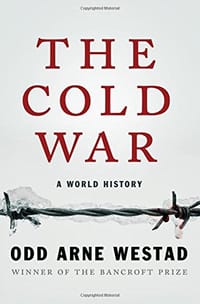
书籍介绍
这本冷战通史最引争议之处,在于作者文安立放弃了早年《全球冷战》里那套鲜活的第三世界能动性叙事,转而采取一种近乎“认同”超级大国的视角,被不少读者视为一种退步。但抛开立场之争,它真正提供的是一个极具解释力的分析框架:冷战的结局不取决于军事强弱的正面对决,而取决于谁能更好地解决本国社会问题、引领新一轮技术革命、并为世界提供更具吸引力的“现代生活”愿景。正因如此,读者普遍感到它不仅可以读懂历史,更能用来观照当下的中美博弈。它适合那些不满足于记诵美苏对抗时间表、而希望把握意识形态如何塑造全球格局的读者;代价则是为了追求“全球性”而牺牲了部分深度。
作者简介
Odd Arne Westad is the S. T. Lee Professor of US-Asia Relations at Harvard University. The author and editor of eleven books, Westad lives in Cambridge, Massachusetts.
AI导读
核心看点
- 超越美苏二元,呈现全球视角的冷战史
- 追溯工业革命根源,解析意识形态对抗
- 揭示冷战思维对当代国际关系的深远影响
读者共识
- 全球史视角独特,有助于理解当今世界
- 部分读者认为深度不及作者早期专著
- 为理解中美博弈及新冷战提供有益参照
精彩摘录
- "Some critics claim that the concept of never-ending economic growth, which may in the longer run threaten human welfare or even the survival of humanity, was-in its modern form-a creation of Cold War competitions"
- "European politics between the 1550s and the early seventeenth century were, for instance, deeply influenced by a bipolar rivalry between Spain and England, which shared some of the characteristics of the Cold War. Its origins were deeply ideological, with Spains monarchs believing they represented C"
- "As industrial society took hold, a number of critiques developed that ques tioned not so much modernity itself, but rather its endpoint. There had to be more, some claimed, to the remarkable transformation of production and society that was going on than making a few people rich and a few European e"
- "The early 1890s therefore saw the first global economic crisis, with high unemployment (nearing 20 percent at one stage in the United States) and massive labor unrest. Many workers and even young professionals-who for the first time faced unemployment in high numbers-asked themselves whether capital"
- "The 1890s therefore saw the final split between mainstream reformist Social Democrats and revolutionary socialists-soon again to call themselves Communists"
- "ideas and a sense of destiny played essential roles in Russian and American expansion. Elites in both countries believed that their states were expanding for a reason that the qualities they possessed as peoples earmarked them for predominance within their regions and-eventually-on a global scale. t"
- "By 1941, when both the USSR and the United States entered World War II, the Soviet Union was internally more powerful than ever, but also more isolated internationally. In the fifty years between the American Civil War and World War I, the US gross domestic product (GDP)multiplied more than seven ti"
- "There had been no all-european war for close to a hundred years, and most people as sumed that rational thInking, commitment to peoples welfare, and economic interdependence would prevent one in the future. But worse than the physical effects of total war were its psycho. logical consequences. A who"
用户评论
都说新冷战要开始了。每天饭后一章,把文安立的冷战史翻完了。看的是企鹅2018年的简装版。Trump的言论和口号和当年的里根最相似:make america great (again)。里根终结了détente,强势怼苏联。结论说,美国没有趁着冷战结束的机遇,拓展国际合作机制,而是延续了冷战思维的外交,时刻担忧可能“颠覆”自己的制度和思想。读到最后突然有种冷淡的物质主义观念:冷战的终结和道德的优劣无关,站住了经济和技术,就到了最后。资本主义成了唯一普世的遗产,成了亚洲反过来挑战旧世界的法宝。
a very good perspective, talking about the 20th century history around the cold war.
当作教科书来看非常好 文老师年轻时应该是天天上街游行的欧洲左派青年吧哈哈哈
感觉比不上之前第三世界视角的那本全球冷战,新冷战即使有也不会像上一次的冷战那样
As so often in the Cold War, the logic of the conflict defeated both self-interest and common human decency
Whilst much of the headline history is familiar, there is a wealth of new material that draws together global events, many of which are overlooked in other accounts. It gives a perspective on the 90% of the world population which is not USA.
一千多页的电子书总算啃完了,全球史视角
你可能会关注的书籍
 The Racial Imaginary of the Cold War Kitchen
 Upstaging the Cold War
 Coca-Colonization and the Cold War
 The Last Post-Cold War Socialist Federation
 Klaxon!: Strategic Air Command Alert During the Cold War (Europe@War)

下载
收藏