
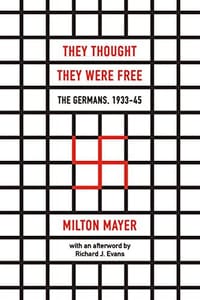
They Thought They Were Free
出版时间
2017-11-05
ISBN
9780226525839
评分
★★★★★
书籍介绍
这不是一本控诉纳粹暴行的书,而是一份令人不安的诊断报告:普通人是如何一步步走进深渊的。作者以美国人的身份,采访十个德国平民——木匠、警察、知识分子——追问他们为何拥抱希特勒。全书最锋利的洞见在于那个反直觉的结论:不是纳粹制造了不自由,而是德国人早有的不自由催生了纳粹。它揭示了一种缓慢而隐蔽的机制:暴政从不以惊天动地的方式降临,而是由数百个'只是更糟一小点'的小步骤累积而成,等你回过神来,世界早已改变。它适合所有相信'这种事不会发生在自己身上'的人——因为当选择被一点点收走,我们甚至来不及察觉自己已不再自由。
作者简介
Milton Sanford Mayer (1908-1986) was a journalist and educator. He was the author of about a dozen books.
He studied at the University of Chicago from 1925 to 1928 but he did not earn a degree; in 1942 he told the Saturday Evening Post that he was "placed on permanent probation for throwing beer bottles out a dormitory window." He was a reporter for the Associated Press, the Chicago Evening Post, and the Chicago Evening American. He wrote a monthly column in the Progressive for over forty years. He won the George Polk Memorial Award and the Benjamin Franklin Citation for Journalism.
He worked for the University of Chicago in its public relations office and lectured in its Great Books Program. He also taught at the University of Massachusetts, Hampshire College, and the University of Louisville. He was an adviser to Robert M. Hutchins when Hutchins founded the Center for the Study of Democratic Institutions.
Mayer was a conscientious objector during World War II but after the war traveled to Germany and lived with German families. Those experiences informed his most influential book They Thought They Were Free: The Germans, 1933-45.
AI导读
核心看点
- 本书基于作者对十位普通德国纳粹党员的深度访谈,揭示了一个令人战栗的真相:纳粹并非通过暴力强制,而是通过迎合民众对秩序、归属感和经济稳定的渴望,以‘欢呼与呐喊’的方式被德国人主动接纳。它警示我们,极权主义的土壤往往源于民众对政治权利的冷漠和对‘小确幸’的过度追求,而非单纯的恐惧。
- 书中深刻剖析了‘去人性化’先于‘去道德化’的机制。在压力与体制的裹挟下,普通人逐渐丧失独立思考能力,将个人命运完全依附于国家机器。这种对‘常态’的盲从和对‘不惹麻烦’的执念,使得个体在一步步滑向深渊时,竟自以为拥有自由,实则已沦为体制的附庸,丧失了作为人的主体性。
- 作者通过记录这些‘小人物’的自我辩护与逻辑自洽,展现了平庸之恶的生成过程。受访者并非天生邪恶,而是缺乏政治权利意识,认为国家崇高而个体无足轻重。这种将个人利益与体制绑定、对体制弊端视而不见的心态,正是极权主义得以蔓延的社会心理基础,对当今社会仍具强烈的现实警示意义。
读者共识
- 读者普遍认为本书具有极强的现实警示意义,尽管成书于上世纪50年代,但其对人性弱点、政治冷漠及极权主义心理机制的剖析,在当今社会依然振聋发聩。许多读者表示,书中揭示的‘以自由换安稳’的逻辑在当下依然可见,提醒人们警惕任何形式的思想控制与道德妥协,坚守公民意识。
- 多数读者赞赏作者通过微观访谈揭示历史真相的勇气与深度,认为其打破了‘受害者-加害者’的二元对立,展现了普通人如何在不知不觉中成为暴政帮凶的复杂过程。但同时也指出,书中缺乏女性视角是一大遗憾,且部分理论阐述过于抽象,阅读体验较为沉重,需耐心咀嚼。
- 读者共识认为,本书并非简单的历史回顾,而是一面映照当下的镜子。它不提供简单的答案,而是迫使读者直面人性的黑暗面与社会责任的缺失。尽管存在时代局限性和翻译问题,但其核心观点——即极权主义源于民众的主动迎合与放弃思考——被广泛认可为深刻的社会洞察,值得反复研读与反思。
精彩摘录
- "Men under pressure are first dehumanized and only then demoralized, not the other way around. Organization and specialization, system, subsystem, and supersystem are the consequence, not the cause, of the totalitarian spirit. National Socialism did not make men unfree; unfreedom made men National So"
- "一个人全然不知道走向哪里,该如何走。相信我,这是真的。每一次行动,每一次时机都比上次更糟,但只是更糟一小点。你等着下一次和下一次的下一次。你等着一次令人震惊的重大时刻,你想着其他人在这种震惊发生的时候,会和你一起进行某种抵抗。你仅仅是不想行动,甚或说话;你不想‘背离你的常态去惹麻烦’。为什么不?好吧,你不习惯这样做。束缚住你的不仅仅是恐惧,独自站出来的恐惧;而且还有真正的不确定性。 如果这整个政权的最后和最恶劣的行径是在他们最初和最轻微的行径之后就发生了的话,是足以令数千人甚至令几百万人感到震惊——让我们假设,1943年用毒气杀死犹太人这次事件,紧接着发生在1933年那件把’德国人商铺‘的标签"
- "Now I see a little better how Nazism overcame Germany ~ not by attack from without or by subversion from within, but with a whoop and a holler. It was what most Germans wanted~ or, under pressure of combined reality and illusion, came to want. They wanted it; they go it; and they liked it."
- "Nations are made not of oak and rock but of men, and as the men are, so will the nations be."
- "德国人的政治冷漠(与美国人相比)体现在更深的层面。他们通常缺少美国人(和英国人、法国人、斯堪的纳维亚人及瑞士人)拥有的那种政治权利意识。他们认为国家是那么的崇高壮丽,而自己是如此无足轻重,他们不可能把自己与国家的实际运行联系在一起。"
- "当我说中高地德语研究是我的生命的时候,你应该会理解我。它是我关心的一切。我是为学者,是位专家。然后,我突然被投入到全新的行动中整个大学都被拖进了新的危局中;集会、协商会、谈话和各种仪式,尤其是各种要充实完善的文件、报告、目录、列表和调查问卷。而除此之外,还有共同体的一些要求和那些以前从没有或者不曾重要的,但现在人们必须或者‘被指望’参加的事情。所有这一切当然都是繁文缛节,但耗费了人们的全部精力,完全挤压掉了人们真正想做的工作。您现在能够理解在那个时候不去思考根本性的事物是多么容易。人们没有时间。"
- "因为纳粹强调的非智识品性(爱国主义、忠诚、责任、纯洁、劳动、简朴、“血脉”和“民族性”)渗入了整个德国。"
- "Grimly preoccupied with themselves; deadly serious and deadly dull (only germans could have been unbored by hitler); tense, hurried, unrelaxed; purpose-bedeviled, always driven somewhere to do something; taking the siesta like communion, with determined, urgent intent; sneering, and not always gente"
用户评论
他们曾经以为的黄金时代,却是众人口诛笔伐的时代。写作者是一直把自己放在对立面去看这些受访人,以一个美国人的姿态,这样ethnographic的视角也会多少有失偏颇吧。
此书的精华在第一和第二部分,第三部分可略读。战后历史证明先进制度可以长久促进经济发展和创新,涤荡民族主义,改造国民精神;但这种规模和程度的改造,前提是彻底和无条件的战败。没有毁灭就没有新生。
原本以为会有很多普通人的故事,结果是大段大段的对话和理论,有点枯燥
历史的echo和rhyme
像
@2022-09-26 10:58:55
University Of Chicago Press的其他书籍查看全部
 Marx’s Dream
 Learning from Shenzhen
 A Significant Life
 Neither Donkey nor Horse
 Wrong-Doing, Truth-Telling
 Unearthing the Nation
下载
收藏