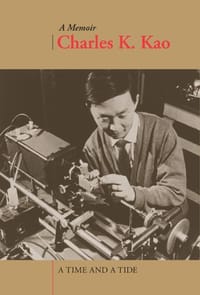
Sir Charles Kao is generally regarded as the father of fiber optics, based in part on his discovery that signal loss in fiber cables was a direct result of impurities in the glass rather than a flaw in the technology—a breakthrough that affects nearly every aspect of our present-day communication infrastructure. Awarded the Nobel Prize in Physics in 2009 "for groundbreaking achievements concerning the transmission of light in fibers for optical communication," this memoir chronicles the personal and scientific odyssey of one of the twentieth century's most influential scientists. Beginning with his childhood in war-torn Shanghai and Hong Kong, Kao explores the turbulent rift that forced him from his family. Later, he details his early work and experience that established the basis for his seminal research with glass fibers in the 1960s. Following this groundbreaking work, the memoir covers Kao's time as a professor and Vice Chancellor of The Chinese University of Hong Kong up until 2009 when he was awarded the Nobel Prize in Physics.
Book Reviews:
"There was an awareness of the potential of optical communication more than 50 years ago... the fibers that were available did not work, after 20 meters most of the light was gone....[that] was the key work of Kao.... He was able to identify what the problem was and devise a pathway to successful fabrication of the fibers that eventually lead to what we have today ... more than a billion kilometers of fibers all around the world that connect us almost instantly, and this is due to the work of Kao."
── Joseph Nordgren,
Chairman of the Nobel Committee for Physics
"Sir Charles' discoveries can be said to have truly changed the world. He opened up the possibilities of broadband communications and the technology he pioneered means that more knowledge, information and ideas are widely available than at any time in history."
── Jim McDonald,
Principle and Vice-Chancellor of University of Strathclyde, Glasgow,
Presenter of Noble Prize
"I first came to know Professor Kao when he joined Chinese University as the Vice-Chancellor in 1987. He won the respect of colleagues and students alike.... Today, Professor Kao's reputation extends way beyond that of professor or even Vice-Chancellor.... His work has fundamentally transformed lives and the way we learn, play, communicate and conduct business.
Equally important, Professor Kao's achievements and commitment have inspired young scientists to dedicate themselves to pushing the boundaries of scientific research."
── Donald Tsang,
Chief Executive and President of the Executive Council of
the Government of Hong Kong
Born in Shanghai in 1933, Sir Charles K. Kao moved to Hong Kong in 1948, eventually joining the staff at The Chinese University of Hong Kong. He founded the university's Department of Electronics (later the Department of Electronic Engineering) in 1970 and taught for many years before serving as Vice Chancellor. In addition to the Nobel Prize in Physics, he has won numerous oth...