
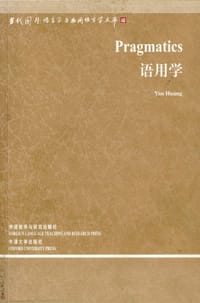
书籍介绍
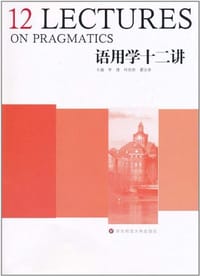
《语用学》一书作者对语用学与句法学以及语义学的界面进行研究,为我们展现出了一幅比较完整的语用学研究图景。全书『见解独到、内容新颖,是一部优秀的语用学教科书。《语用学》作者黄衍早年留学英国,师从著名语用学家Stephell C.Levinson,获剑桥大学博士学位,后冉获牛津大学博士学位,并曾在这两所人学及雷丁大学执教。黄衍现为新西兰奥克兰久学语言学及应用语言学系教授。
当代国外语言学与应用语言学文库
目录
PrefaceAcknowledgementsSymbols and abbreviations1. Introduction 1.1. What is pragmatics? 1.1.1. A definition 1.1.2. A brief history of pragmatics 1.1.3. Two main schools of thought in pragmatics: Anglo-American versus European Continental 1.2. Why pragmatics? 1.2.1. Linguistic underdeterminacy 1.2.2. Simplification of semantics and syntax 1.3. Some basic notions in semantics and pragmatics 1.3.1. Sentence, utterance, proposition 1.3.2. Context 1.3.3. Truth value, truth condition, entailment 1.4. Organization of the book Key concepts Exercises and essay questions Further readingsPart Ⅰ Central topics in pragmatics2. Implicature 2.1. Classical Gricean theory of conversational implicature 2.1.1. The co-operative principle and the maxims of conversation 2.1.2. Relationship between the speaker and the maxims 2.1.3. Conversational implicatureo versus conversational implicatureF 2.1.4. Generalized versus particularized conversational implicature 2.1.5. Properties of conversational implicature 2.2. Two neo-Gricean pragmatic theories of conversational implicature 2.2.1. The Hornian system 2.2.2. The Levinsonian system 2.3. Conventional implicature 2.3.1. What is conventional implicature? 2.3.2. Properties of conventional implicature 2.4. Summary Key concepts Exercises and essay questions Further readings3. Presupposition 3.1. What is presupposition? 3.2. Properties of presupposition 3.2.1. Constancy under negation 3.2.2. Defeasibility 3.2.3. The projection problem 3.3. Analyses 3.3.1. The filtering-satisfaction analysis 3.3.2. The cancellation analysis 3.3.3. The accommodation analysis 3.4. Summary Key concepts Exercises and essay questions Further readings4. Speech acts 4.1. Performatives versus constatives 4.1.1. The performative/constative dichotomy 4.1.2. The performative hypothesis 4.2. Austin's felicity conditions on performatives 4.3. Locutionary, illocutionary, and perlocutionary speech acts 4.4. Searle's felicity conditions on speech acts 4.5. Searle's typology of speech acts 4.6. Indirect speech acts 4.6.1. What is an indirect speech act? 4.6.2. How is an indirect speech act analysed? 4.6.3. Why is an indirect speech act used? Some remarks on politeness 4.7. Speech acts and culture 4.7.1. Cross-cultural variation 4.7.2. Interlanguage variation 4.8. Summary Key concepts Exercises and essay questions Further readings5. Deixis 5.1. Preliminaries 5.1.1. Deictic versus non-deictic expression 5.1.2. Gestural versus symbolic use of a deictic expression 5.1.3. Deictic centre and deictic projection 5.2. Basic categories of deixis 5.2.1. Person deixis 5.2.2. Time deixis 5.2.3. Space deixis 5.3. Other categories of deixis 5.3.1. Social deixis 5.3.2. Discourse deixis 5.4. Summary Key concepts Exercises and essay questions Further readingsPart Ⅱ Pragmatics and its interfaces6. Pragmatics and cognition: relevance theory 6.1. Relevance 6.1.1. The cognitive principle of relevance 6.1.2. The communicative principle of relevance 6.2. Explicature, implicature, and conceptual versus procedural meaning 6.2.1. Grice: what is said versus what is implicated 6.2.2. Explicature 6.2.3. Implicature 6.2.4. Conceptual versus procedural meaning 6.3. From Fodorian 'central process' to submodule of 'theory of mind' 6.3.1. Fodorian theory of cognitive modularity 6.3.2. Sperber and Wilson's earlier position: pragmatics as Fodorian 'central process' 6.3.3. Sperber and Wilson's current position: pragmatics as submodule of 'theory of mind' 6.4. Relevance theory compared with classical/neo-Gricean theory 6.5. Summary Key concepts Exercises and essay questions Further readings7. Pragmatics and semantics 7.1. Reductionism versus complementarism 7.2. Drawing the semantics-pragmatics distinction 7.2.1. Truth-conditional versus non-truth-conditional meaning 7.2.2. Conventional versus non-conventional meaning 7.2.3. Context independence versus context dependence 7.3. Pragmatic intrusion into what is said and the semantics-pragmatics interface 7.3.1. Grice: what is said versus what is implicated revisited 7.3.2. Relevance theorists: explicature 7.3.3. Recanati: the pragmatically enriched said 7.3.4. Bach: conversational impliciture 7.3.5. Can explicature/the pragmatically enriched said/impliciture be distinguished from implicature? 7.3.6. Levinson: conversational implicature 7.3.7. The five analyses compared 7.4. Summary Key concepts Exercises and essay questions Further readings8. Pragmatics and syntax 8.1. Chomsky's views about language and linguistics 8.2. Chomsky's binding theory 8.3. Problems for Chomsky's binding theory 8.3.1. Binding condition A 8.3.2. Binding condition B 8.3.3. Complementarity between anaphors and pronominals 8.3.4. Binding condition C 8.4. A revised neo-Gricean pragmatic theory of anaphora 8.4.1. The general pattern of anaphora 8.4.2. A revised neo-Gricean pragmatic apparatus for anaphora 8.4.3. The binding patterns 8.4.4. Beyond the binding patterns 8.4.5. Logophoricityandemphaticness/contrastiveness 8.5. Theoretical implications 8.6. Summary Key concepts Exercises and essay questions Further readingsGlossaryReferencesSuggested solutions to exercisesIndex of namesIndex of languages, language families, and language areasIndex of subjects
用户评论
论文参考书目 语用学
太晦涩了。书写的也不好。
当年差点跟这位先生读了博士。老先生固然博学,但这本书显然并不简单。
又,国内写的语用学入门书的人,没一个是有水平的,能把言语行为这些东西讲清楚就不错了,更难的部分基本略过,毕竟自己也搞不懂。这导致大多数学生都觉得语用学是个相对简单的学科。看看这本书,或levinson那本,就会知道完全不是那么回事。
非常晦涩的一本书,读完了也不知所云,更多的可能是因为我自身能力有限。结合了一些论文,勉强觉得理解了轮廓,但让我自己讲出来又不会。



求书
收藏