
书籍介绍
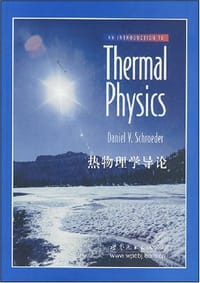
本书是一部全面介绍热物理学入门的本科生教程(全英文版)。该书的内容分为三大部分:第1部分介绍了热物理学基本原理;第2,3部分分别详细介绍了热动力学和统计力学技巧以及它们的在实践中的应用。本书最大的特点是内容广泛,结合实际,形象易懂,包含了尽可能多的应用实例,涉及诸多领域,例如,化学、生物、地理、环境科学、工程、低温物理、固态物理、宇宙学、天体物理学等。这本书浅显易懂,只要能够了解基本物理学以及一年的微积分就可以读懂这本书。本书还给出了一个附录,其中包括一些书中用到的必需结果。
AI导读
核心看点
- 本书严格遵循物理直觉,拒绝空洞的数学推导,所有概念引入均基于自然逻辑,无“显然”等跳步,确保读者建立清晰物理图像。
- 内容涵盖热力学与统计力学全貌,从基本原理到量子统计,结合化学、生物、天文等多领域实例,展现物理学的广泛应用价值。
- 习题设计极具引导性,难题拆解为多步小问题,逐步引导正确思路,配合风趣配图,大幅降低学习门槛,提升理解深度。
适合谁读
- 物理、化学、材料、工程等专业的本科生,急需一本逻辑清晰、无晦涩推导、能真正理解热力学与统计力学本质的入门教材。
- 曾被传统教材(如汪志诚版)劝退的读者,希望以友好、直观、符合物理直觉的方式重新学习热统,建立正确理论框架。
- 对跨学科应用感兴趣的科学爱好者,希望了解热力学原理在低温物理、宇宙学、环境科学等前沿领域的实际运作机制。
读前提醒
- 本书为全英文影印版,需具备基础英语阅读能力;作者强调物理图像优先,部分细节逻辑可能简化,需配合其他资料补充严谨性。
- 务必动手完成课后习题,这是本书核心价值所在;习题难度循序渐进,切勿跳过,否则无法体会作者精心设计的引导式学习路径。
- 阅读时需警惕书中淡化或略过的常规概念,虽为突出主体,但可能影响后续高阶学习,建议结合其他教材查漏补缺。
读者共识
- 被公认为最友好的热统入门书,概念引入自然,无垃圾教材套路,配图幽默,习题质量极高,完美符合优秀教科书标准。
- 强烈建议替换传统教材,读者反馈读后豁然开朗,物理图像清晰,理论框架搭建迅速,对初学者极其友好且高效。
- 尽管存在逻辑简化争议,但瑕不掩瑜,其突出主体、避免读者淹没于细节的设计广受好评,是热统学习的最佳起点。
本导读基于书籍简介、目录、原文摘录、短评和书评生成,不等同于全文精读。
精彩摘录
- "The second law is not built into the fundamental laws of nature, though; it arises purely through the laws of probability and the mathematics of very large numbers. But since the probabilities are so overwhelming for any system large enough to see with our eyes, we might as well forget about probabi"
- "Entropy is the more fundamental quantity, governed by the second law of thermodynamics. Temperature is less fundamental; it is merely a characterization of a system's "willingness" to give up energy, that is, of the relationship between its energy and entropy."
- "thermodynamic identity: dU = T*dS - P*dV + ∑ μ*dN."
- "Extensive and Intensive Quantities The number of potentially interesting thermodynamic variables has been growing lately. We now have U, V, iV, S, T, P, /i, H, P, and G, among others. One way to organize all these quantities is to pick out the ones that double if you simply double the amount of stuf"
- "Because a system will spontaneously seek out the state of lowest free energy, this property tells us that equilibrium phases almost always contain impurities."
- "The usefulness of the formula F = -k*T* In Z is that from F we can compute the entropy, pressure, and chemical potential, using the partial-derivative formulas"
- "Degeneracy pressure is what keeps matter from collapsing under the huge electrostatic forces that try to pull electrons and protons together. Please note that degeneracy pressure has absolutely nothing to do with electrostatic repulsion between the electrons (which we've completely ignored); it aris"
- "Heat is defined as any spontaneous flow of energy from one object to another, cause by a difference in temperature between the objects."
目录
PartI:Fundamentals
Chapter1 Energy in Thermal Physics
Chapter2 The Second Law
Chapter3 Interactions and Implications
PartII:Thermodynamics
显示全部
用户评论
这本热力学编的真不错!
最好的热学入门书籍,大一寒假刷完感觉写得太好,写得非常容易理解,习题也都出现得恰到好处,完美的物理学教科书应该有的样子。
最为友好的热力学统计物理入门书!概念的引入十分自然,而且配图风趣幽默,课后习题都是作者精心挑选的,质量很高,强烈推荐啊!
很好的一本热力学教材,讲解很细致,也涵盖了最新的领域。






收藏