
![国际经济学 - [美] 保罗·克鲁格曼, 茅瑞斯·奥伯斯法尔德](https://static.book345.com/covers/s/9787300040189.jpg)
书籍介绍
这本《国际经济学》最耐人寻味的地方,或许正在于它被不少读者反复念叨的
作者简介
保罗·克鲁格曼(Paul R. Krugman),美国普林斯顿大学国际经济学教授。
茅瑞斯·奥伯斯法尔德(Maurice Obstfeld),美国加利福尼亚大学伯克利分校经济学教授。
AI导读
核心看点
- 诺贝尔奖得主克鲁格曼经典教材
- 深入剖析国际贸易与金融体系
- 逻辑严密,图表丰富辅助理解
读者共识
- 翻译质量高,阅读体验优于国教
- 难度适中,性价比极高的经典
- 部分章节晦涩,建议跳读难点
精彩摘录
- "Countries engage in international trade for two basic reasons, each of which contributes to their gains from trade. First, countries trade because they are different from each other. Nations, like individuals, can benefit from their differences by reaching an arrangement in which each does the thing"
- "unit labor requirement, the number of hours of labor required to produce"
- "The production possibility frontier illustrates the different mixes of goods the economy can produce. relative price of the economy’s two goods, that is, the price of one good in terms of the other. What is the significance of the number ? We saw in the previous section that it is the opportunity co"
- "In the absence of trade, the relative prices of cheese and wine in each country would be determined by the relative unit labor requirements."
- "partial equilibrium analysis, that is, to study a single market"
- "The first way to show that specialization and trade are beneficial is to think of trade as an indirect method of production. Another way to see the mutual gains from trade is to examine how trade affects each country’s possibilities for consumption.In each case, trade has enlarged the range of choic"
- "The relative wage of a country’s workers is the amount they are paid per hour, compared with the amount workers in another country are paid per hour."
- "The competitive advantage of an industry depends not only on its productivity relative to the foreign industry, but also on the domestic wage rate relative to the foreign wage rate."
你可能会关注的书籍
 国际经济学(第四版)
 国际经济学:理论与政策(第10版)
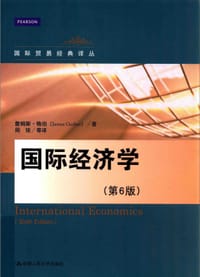 国际经济学(第6版)
 国际经济学:理论与政策(国际金融)(全球版 第10版)(清华经济学系列英文版教材)
 国际经济学:理论与政策(国际贸易) (全球版 第10版)(清华经济学系列英文版教材)






下载
收藏