
书籍介绍
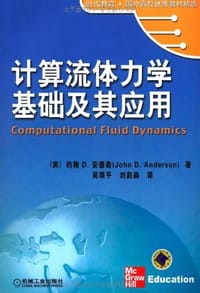
《计算流体力学基础及其应用》是计算流体力学(CFD)方面的入门书。本书首先介绍了计算流体力学的基础知识,然后通过四个精心挑选的例子介绍了计算流体力学中的重要方法和处理技巧。这些例子都有理论上的解析解,读者可以将cFD计算的结果与解析解进行对比,从而更深入地了解cFD的基本概念、思路、方法、用途和优缺点。在此基础上,本书的最后一部分介绍了计算流体力学中的几个前沿问题。
精彩摘录
- "There is a subtle difference between the integral and differential forms of the governing flow equations which is best noted at this stage. The integral form of the equations allows for the presence of discontinuities inside the fixed control volume(fixed in space); there is no mathematical reason t"
- "This motivation is driven by more than just trying to minimize the truncation error with closely spaced points; it is also a matter of simply having enough grid points to properly capture the physics of the flow(in those regions of the flow where large gradients in the flow-field properties exist)."
- "The numerical solution of a partial differential equation is influenced by two sources of errors: Discretization error, the difference between the exact analytical solution of the partial differential equation and the exact solution of the corresponding difference equation. From the discussion in Se"
- "In pricinple, we can only hope that the numerical results give values for T which represent those that would be obtained from a closed-form analytical solution of the original partial differential equation, at least within the truncation error. Some confidence in this regard can be ontained if we ca"
- "If the round-off error are already present at some stage of the solution of the equation(as they always are in any real computer solution), then the solution will be stableif the round-off error shrink, or at best stay the same, as the solution progresses from step n to n+1."
- "Because the conservation form of the equations does a better job of conserving mass throughout the flow field, we can begin to understand why they are labeled the conservation form."
目录
用户评论
2009.5.13/
不得不佩服安德森大叔,算得上开山祖师爷的级别了。
边看边忘,我不是纯作计算的。
读还是读了几遍。主要是气体可压流;
少有的看了可以停不下来的专业书,看其他人写的真想撞死在墙上
深入浅出的好书!
写的非常易懂好读,非常适合CFD入门。流体系研一学生。
CLASSIC 随便翻了翻
无敌的
李希的书👋






下载
收藏