
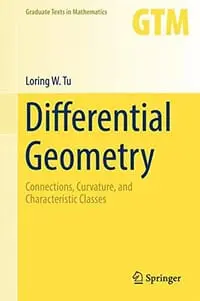
书籍介绍
This text presents a graduate-level introduction to differential geometry for mathematics and physics students. The exposition follows the historical development of the concepts of connection and curvature with the goal of explaining the Chern–Weil theory of characteristic classes on a principal bundle. Along the way we encounter some of the high points in the history of differential geometry, for example, Gauss' Theorema Egregium and the Gauss–Bonnet theorem. Exercises throughout the book test the reader’s understanding of the material and sometimes illustrate extensions of the theory. Initially, the prerequisites for the reader include a passing familiarity with manifolds. After the first chapter, it becomes necessary to understand and manipulate differential forms. A knowledge of de Rham cohomology is required for the last third of the text.
Prerequisite material is contained in author's text An Introduction to Manifolds, and can be learned in one semester. For the benefit of the reader and to establish common notations, Appendix A recalls the basics of manifold theory. Additionally, in an attempt to make the exposition more self-contained, sections on algebraic constructions such as the tensor product and the exterior power are included.
Differential geometry, as its name implies, is the study of geometry using differential calculus. It dates back to Newton and Leibniz in the seventeenth century, but it was not until the nineteenth century, with the work of Gauss on surfaces and Riemann on the curvature tensor, that differential geometry flourished and its modern foundation was laid. Over the past one hundred years, differential geometry has proven indispensable to an understanding of the physical world, in Einstein's general theory of relativity, in the theory of gravitation, in gauge theory, and now in string theory. Differential geometry is also useful in topology, several complex variables, algebraic geometry, complex manifolds, and dynamical systems, among other fields. The field has even found applications to group theory as in Gromov's work and to probability theory as in Diaconis's work. It is not too far-fetched to argue that differential geometry should be in every mathematician's arsenal.
AI导读
编辑书评
- Loring W. Tu的《Differential Geometry》是一部典型的“偏科”佳作。它的真正价值不在于全面覆盖微分几何的所有分支,而在于提供了一条通往现代几何核心——主丛与陈类——的最短路径。相较于Spivak的厚重或Kobayashi-Nomizu的艰深,Tu选择了牺牲前半部分的深度来换取后半部分的可读性。这种策略对于非纯几何方向的数学物理学者极具吸引力,因为它解决了“知道要学什么,却不知道从何入手”的痛点。然而,这种取舍也导致了结构的失衡,前半部分沦为陪衬,使得整本书更像是一个精心包装的高级讲义,而非严谨的教科书。
- 这本书是否值得读,取决于你的目标。若你想系统学习黎曼几何,请转向Do Carmo;若你想钻研代数拓扑与几何的深层联系,请等待更专业的专著。但对于处于两者之间、急需建立“几何对象如何通过联络产生拓扑不变量”这一直觉的读者,本书几乎是不可替代的。它的局限在于对前置知识假设过高,而对中间步骤铺垫不足,导致读者常在“看懂字面意思”与“理解数学本质”之间徘徊。建议在拥有导师指导或配合视频课程的情况下使用,否则极易在第六章的陈类构造处迷失。总体而言,它是一本优秀的“第二本”微分几何书,而非第一本。
核心看点
- 本书以历史发展为线索,从古典微分几何的高斯绝妙定理、高斯-博内定理出发,逐步过渡到现代主丛上的联络与曲率理论。其核心意图在于通过清晰的逻辑链条,最终解释陈-韦伊(Chern-Weil)特征类理论,为读者构建从直观几何到抽象拓扑的桥梁。
- 后半部分尤其是关于主丛(Principal Bundle)的章节被公认为全书精华。作者Loring W. Tu擅长将复杂的纤维丛概念进行降维处理,使得原本晦涩的现代几何语言变得流畅易懂。对于希望深入理解规范场论数学基础的物理系学生或几何初学者而言,这部分内容提供了极佳的入门路径。
- 作为GTM系列教材,本书在习题设计上注重对概念理解的检验而非单纯计算技巧。虽然前半部分黎曼几何内容相对初等且存在重复编排,但整体结构紧凑,旨在让具备流形基础知识的读者能够独立掌握微分形式运算及上同调的基本应用,强调直觉与严谨性的平衡。
读者共识
- 读者普遍认可后半部分(特别是主丛和特征类章节)的清晰度与易读性,认为其比许多同类高阶教材更友好。然而,对于前半部分黎曼几何的内容,共识是略显单薄、重复且过于初等,甚至被认为不如直接阅读Do Carmo或陈维恒的经典著作高效。
- 评价呈现两极分化:代数背景强但分析弱的读者常因缺乏流形直觉而感到困难;反之,几何直觉好的读者则能享受其流畅的叙述。多数评论提到“最后一章看不懂”或“前面太简单后面太难”,反映出该书在难度梯度衔接上存在一定断层,需读者自行补足中间环节。
- 尽管有批评声音,仍有相当数量的读者给予高分,称其“值得读了再读”、“写得高级”。大家一致认为,虽然选题编排有瑕疵(如R^3与向量丛上的重复讲解),但作为一本通向现代几何核心的桥梁书,其核心价值在于用通俗语言拆解了陈-韦伊理论的复杂性。
用户评论
5/2, chern class没看懂。为什么总是一本书的最后几章看不懂呢?
(读了一半,先记一下
做个简短评价吧,前半部分黎曼几何写的很初等,更好的是去上手do carmo或者陈维恒的黄皮。不过后半部分,尤其是最后一章principal bundle上,写的真的非常清晰易懂,想学主丛上的联络的我觉得这本书是个很好的参考。
Loring的书讲得肯定没问题,但是选题和编排真是有点离谱,同样的东西R^3上讲一次,vector bundle上讲一次。一直在重复,实际整本书内容就非常少,也太简单了,讲了很多古典的东西。其实主要就为了看最后的characteristic classes。不过这部分也有点太简单
杜老师写的书一如既往的好
整本书非常流畅没有Gap,花三周时间读了一遍,习题以后慢慢做吧

Springer的其他书籍查看全部
 200 Years of Friedrich Engels
 Deepfakes
 Statistical Foundations, Reasoning and Inference: For Science and Data Science
 Introduction to Linear and Matrix Algebra
 Studien zur Struktur des Bewusstseins
 nternet of Things (IoT)