
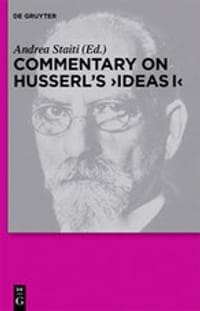
Husserl's Ideas for a Pure Phenomenology and Phenomenological Philosophy (1913) is one of the key texts of twentieth century philosophy. It is the first of Husserl's published works to present his distinctive version of transcendental philosophy and to put forward the ambitious claim that phenomenology is the fundamental science of philosophy. In Ideas, Husserl introduces for the first time the conceptual arsenal of his mature phenomenology: the principle of all principles, the phenomenological epoché and reduction, pure consciousness, and the noema. All these difficult notions have been influential and controversial in subsequent philosophy, both analytic and Continental. In this commentary, thirteen leading scholars of Husserlian phenomenology set out to clarify and defend Husserl's views, connecting them to the vast corpus of his published and unpublished writings, and discussing the main available interpretations in the existing scholarship. The result is a detailed and comprehensive account of the most original form of transcendental philosophy since Kant's Critique of Pure Reason.
Andrea Staiti趁观念1出版100周年之际在Boston College办了一个关于观念1的workshop (November 8th–10th). 这部书就是这个workshop的产物。
“ a multi-layer reading of a text in which plain (and allegedly “neutral”) explanation and “critical” interpretation meet halfway, build upon each other, and support each other in an unprecedented manner.” (Daniele De Santis)
 Leben und Fabeln Äsops
 Saffo Testimonianze e frammenti
 Hegels "Lehre vom Wesen"
 The Poetry of Du Fu
 Syntax - Theory and Analysis Vol.1
 Die Philosophie des Xenokrates im Kontext der Alten Akademie