
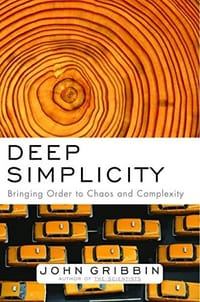
书籍介绍
这本书最勾人也最让人半途而废的,是它试图把混沌与复杂这两大现代科学革命,收进
AI导读
核心看点
- 揭示混沌与复杂性理论如何解释世界
- 探讨从牛顿到达尔文的科学思想演变
- 阐释简单规则如何涌现出复杂表象
读者共识
- 核心观点深刻,但部分章节略显晦涩
- 翻译版本质量参差不齐,建议慎选
- 提供认知复杂世界的全新思维工具
精彩摘录
- "Life, of course, seems to defy this process, by creating order and structure out of disordered (or at least, less ordered) materials. A plant builds its structure, and may make beautiful flowers, out of carbon dioxide, water, and a few traces of other chemicals. But it only does so with the aid of s"
- "Away from equilibrium, a flow of energy can, under the right circumstances, create order spontaneously. This is a crucial insight into our own existence, since there is no denying that we are ordered creatures, and there is overwhelming evidence that the Universe began in a state of much less order."
- "In a sense, classical thermodynamics pretends that time does not exist. ... Classical thermodynamics also assumes that there is no flow of energy – specifically, heat – through a system. ... Dissipation of energy is an essential feature of non-equilibrium thermodynamics, giving us another way of ref"
- "Turing showed that there are systems which cannot be ‘compressed’ algorithmically, and whose most compact representations are themselves – one of the key concepts we encountered, from another direction, in our earlier discussion of chaos. In particular, as we have seen, the shortest description of t"
- "当然,动物不见得一定会有图案,即使相关的生化机制确实存在。这种机制可以被关掉,我们从进化的角度很容易看出,比如像北极熊就只有单一的白色外表。但当图案显现时,由表面大小产生不同图案的关联性,我们可以从猫科动物的尾巴上找到一个十分有趣的例子。对于基本上是柱状的尾巴,图案可能是斑点或环绕尾巴的圆环。但像美洲豹,即使开始时以斑点覆盖,到了尾巴末端,尾尖上形成的仍是条纹图案,这与模型所预测的条纹出现在较小表面,斑点出现在较大表面的结果一致。 这个模型有个重要特质,动物表面图案并非取决于成年动物的大小与形状,而取决于图灵式的过程发生时胚胎的大小与形状。当然,大象胚胎会比老鼠胚胎大;但胚胎大小的重要性可以从"
- "但当我终于知道混沌是怎么一回事时,我还是大吃一惊。我的理解是:重点只在于某些系统(“系统”包含的范围可以很广,比如摆荡的钟摆、太阳系或水龙头的滴水规律)对于初始条件非常敏感,因此初始“那一刹那”的少许差异,会造成截然不同的结果。此外,还有“反馈( feedback),反馈使得系统会影响自身的行为。这一切看起来太完美了,简单得令人难以置信!因此当我请教朋友吉米・拉夫洛克( Jim Lovelock)时,我问道:“是否混沌和复杂所探讨的一切,只是建立于两个简单的概念之上——系统对初始状态的敏感以及回馈?”他回答:“一点几也没错,全都包在里面。”"
- "我们今天所知道的热力学第二定律有许多不同的表达方式,在1852年首度清楚地提出这个理论的事英国乌鲁学家威廉汤姆森,他把重点放在‘散失(Dissipation)’的观念上。虽然大自然的运作可以被看成一个将热转换为功(或运动)的巨大机器,总会有一些热在这个过程中散失;不是真的消失,只是扩散到整个宇宙中,使其整体温度升高一些。这个主张脱离了当时能量守恒定律(热力学第一定律)的概念,因为这样一来,虽然宇宙的总能量不变,‘可使用能量’却不断减少。这促使物理学家必须想出方法量化一个封闭系统(整个宇宙)中可使用的能量,才能界定其数值并用方程式处理。因此,德国的克劳修斯在1860年代中期提出了‘熵(entro"
- "这故事还有个情节。就目前所知,我们有这样大的卫星——月亮——最佳解释是在太阳系形成早期,有一个接近火星大小的小星体,因为混沌作用脱离小行星带撞上地球,而溅起的熔化物质在太空中形成月亮。"
用户评论
标题党,人生的努力方向
纯生物进化无人类,无收获看不下去
这类书普遍的一个问题是涉猎太宽,章与章之间的关系就散了。深奥的简洁的思路在1/f这个公式上体现比较明显,其他的就差一些
看看
好多次阅读的时候灵光一现。不过,一下又没了。
是本好书 但是好多都看得我晕晕的…不懂啊
Random House的其他书籍查看全部
 Jennifer Chan Is Not Alone
 Adriatic
 A Swim in a Pond in the Rain
 Blowout
 The Second Mountain
 Dreyer's English
下载
收藏