
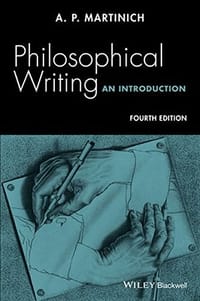
书籍介绍
这不是一本教你如何写出优美文字的文学写作指南,而是一部训练哲学思维的实战手册。它的核心主张朴素而尖锐:哲学写作的目标是真理,而真理必须用清晰、日常的语言呈现——真正的深刻追求阐明,伪装的深刻才追求晦涩。全书围绕'先写下来'这一反直觉的指令展开:它劝你推迟研究、先动笔、后加注,用一句话锁定论点,再逐层展开论证,以此对抗写作障碍与拖延。读者最看重的,正是这种近乎苛刻的清晰性训练——术语要当作读者一无所知来解释,作者要保持客观却须合乎逻辑,个人情感与私生活被排除在论文之外。它适合那些被'不知从何写起'困住的哲学初学者,也适合愿意把写作当作思考本身来打磨的人。
作者简介
A. P. Martinich is Roy Allison Vaughan Centennial Professor in Philosophy and Professor of History and Government at the University of Texas at Austin. His publications include The Two Gods of Leviathan (1992) and Hobbes: A Biography (1999); and, as co-editor, A Companion to Analytic Philosophy (Blackwell, 2001), Analytic Philosophy, 2nd ed. (Wiley Blackwell, 2012), and The Philosophy of Language, 6th ed. (2013). Martinich is also Vice-President of the Board of Directors of the Journal of the History of Philosophy. Martinich has also contributed to The Philosophers' Magazine and Think.
AI导读
核心看点
- 本书严格界定分析哲学写作规范,强调清晰、有序、结构严谨的表达是追求真理的唯一路径。作者明确反对故弄玄虚的晦涩文风,指出思想深邃者必求清晰,伪深刻者才求模糊,旨在纠正学生常见的逻辑混乱与表达冗余问题。
- 提供标准化的哲学论文结构模板,强制要求开篇即陈述核心论点,随后严格遵循论证有效性验证与前提真实性检验的步骤。书中详细拆解如何构建有效论证,确保前提能逻辑必然地推导出结论,杜绝无效推理。
- 传授具体的写作心理建设与操作技巧,如通过概念笔记克服写作障碍,严禁以‘做研究’为借口拖延动笔。同时指导如何平衡直觉与理论,倡导反思平衡立场,并规范第一人称的使用边界,确保学术客观性。
读者共识
- 读者普遍认可本书在纠正学术写作陋习方面的价值,认为其提供的结构模板极具操作性。尽管部分用户反馈内容啰嗦或例子琐碎,但多数观点认为这种‘啰嗦’体现了作者对学生困境的共情与严谨负责的教学态度。
- 强烈共识认为清晰性是哲学写作的核心美德,任何试图通过模糊语言掩盖思想贫瘠的做法都应被摒弃。读者赞赏作者对‘伪深刻’文风的批判,认为这有助于打破对哲学神秘化的刻板印象,回归理性与诚实。
- 多数读者表示相见恨晚,认为若能在学术训练初期接触此书,可避免大量无效努力。尽管部分高阶读者认为内容基础,但作为规范手册仍具参考价值,尤其对于需要反复查阅论证格式与逻辑规则的学生而言是必备工具书。
精彩摘录
- "The Structure of a Philosophical Essay A Simple One I State the proposition to be proved. II Give the argument for that proposition. III Show that the argument is valid. IV Show that the premises are true. V State the upshot of what has been proven."
- "With this technique, you begin by stating in one sentence the thesis or main point of your essay. In trying to formulate that one sentence, you should not be concerned with what your audience might need as background information and you needn’t be shy of using technical terms. The required backgroun"
- "First, it forestalls writer’s block, which is often caused either by the fear that one has nothing to say or the fear that what one has to say is wrong. The second purpose of conceptual note taking is to provide you with materials to be organized and evaluated in preparation for writing a good first"
- "Doing research keeps you from writing, and starting to write is typically the hardest thing to do; delaying the start seems most attractive to people. Further, research can inhibit your writing. In short, don’t delay; write first; footnote later."
- "The structure and style of a student’s essay should be the same as an essay of straightforward exposition and explanation. All technical terms have to be explained as if the audience knew little or no philosophy. This means that the student ought to explain them by using ordinary words in their ordi"
- "Although physical courage is widely admired and discussed in contemporary society, and, perhaps, unwittingly caricatured in macho men, intellectual courage is not. Too few people have the courage of their convictions; yet convictions on important issues that are the result of investigation and refle"
- "Promoting only intuition or only theory are extreme positions. There is a middle ground between them that promotes what may be called reflective equilibrium. This view holds that philosophy should begin with intuitions; that theorizing should begin by trying to explain those intuitions; that when in"
- "Df(1) An argument is a sequence of two or more propositions of which one is designated as the conclusion and all the others of which are premises. Df(2) A sound argument is an argument which is valid and which contains only true premises. Df(3) An argument is valid if and only if it is necessary tha"
用户评论
trivial的例子和解释太多了
好不容易摸索出一些写作技巧时读这本书,这让我感觉作者有点啰嗦(仍富有启发性)。但啰嗦其实意味作者看到了作为学生的我们在写作时可能犯的错误、同情我们所处的困境、希望教会我们写作的技能、引导我们成长为学者。
有点感慨。国内读书时老师会告诉你要关注宏大主题、要追究重要问题、要读经典不要读垃圾、不要急于求成……我很感激某些教诲和洞见,它们如今也时不时警醒我这个学术农工。但遗憾的是,从来没有人教过我写论文。好像大家都预设了每个学生天生就会写论文,就像一篇糟糕的paper预设了读者一定能理解他高深的表达。没有人教我如何能够将自己的思考以连贯、清晰、简洁的文字形成一篇富有逻辑性 且 kind to reader的论文。
只能靠自己瞎摸黑,他爹的,走了多少弯路流了多少泪!
希望能够重视文科学生的写作教育!
看了半天 学到的可以概括为两句话:In the beginning is the deed; writing must be done in stages.
那些要是我在低年级刚接触写作的时候就能读过的书 就好了。chapter 3的示例加讲解感觉不光是对写作还有对自己阅读哲学文献的帮助也很大。
从零开始的极佳入门书!哲学写作本非难事,奈何无法把真正有价值的想法清晰地表达出来!P S:什么时候各位学界大佬能够少吐槽点学生的写作水平,而是多把精力花在写出这样的入门书上,也许某些人口中学生“糟糕的”写作水平会有更大的提高。
挺好
(分析)哲学写作
写得还行,葛四友感觉特喜欢这书,和他文章、报告内容类似;浅看了分析方法那章,下定义、作区分很有启发!还有归谬法,讲的都蛮清楚。但是有些地方还是没太看懂,比如dialectical argument,,不知道该怎么写,总之这书得多多参考才对,要反复阅读,熟习于心。
恩人 教我怎么写哲学论文
你可能会关注的书籍
 Qabbalah The philosophical writings of Solomon ben Yehudah Ibn Gebirol, or Avicebron
 The Philosophical Writings of Descartes
John Wiley & Sons的其他书籍查看全部
 Bank 4.0
 Word 2019 For Dummies
 Strategy Beyond the Hockey Stick
 Project Management
 Unmasking the Social Engineer
 The Essays of Warren Buffett (4/e)
求书
收藏