
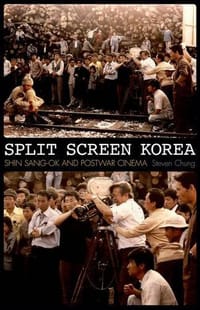
Shin Sang-ok (1926–2006) was arguably the most important Korean filmmaker of the postwar era. Over seven decades, he directed or produced nearly 200 films, including A Flower in Hell (1958) and Pulgasari (1985) and his career took him from late-colonial Korea to postwar South and North Korea to Hollywood. Notoriously crossing over to the North in 1978, Shin made a series of popular films under Kim Jong-il before seeking asylum in 1986 and resuming his career in South Korea and Hollywood.
In Split Screen Korea, Steven Chung illuminates the story of postwar Korean film and popular culture through the first in-depth account in English of Shin’s remarkable career. Shin’s films were shaped by national division and Cold War politics, but Split Screen Korea finds surprising aesthetic and political continuities across not only distinct phases in modern South Korean history but also between South and North Korea. These are unveiled most dramatically in analysis of the films Shin made on opposite sides of the DMZ. Chung explains how a filmmaking sensibility rooted in the South Korean market and the global style of Hollywood could have been viable in the North.
Combining close readings of a broad range of films with research on the industrial and political conditions of Korean film production, Split Screen Korea shows how cinematic styles, popular culture, and intellectual discourse bridged the divisions of postwar Korea, raising new questions about the implications of political partition.
Steven Chung is assistant professor of East Asian studies at Princeton University.
显示全部
 Manifestly Haraway
 Prismatic Ecology
 Political Affect
 The Urban Revolution
 Readings
 Consequences Of Pragmatism