
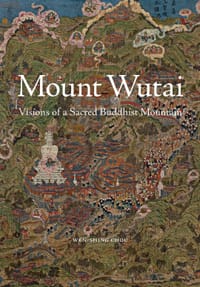
The northern Chinese mountain range of Mount Wutai has been a preeminent site of international pilgrimage for over a millennium. Home t o more than one hundred temples, the entire range is considered a Buddhist paradise on earth, and has received visitors ranging from emperors to monastic and lay devotees. Mount Wutai explores how Qing Buddhist rulers and clerics from Inner Asia, including Manchus, Tibetans, and Mongols, reimagined the mountain as their own during the eighteenth and nineteenth centuries.
Wen-Shing Chou examines a wealth of original source materials in multiple languages and media—many never before published or translated—such as temple replicas, pilgrimage guides, hagiographic representations, and panoramic maps. She shows how literary, artistic, and architectural depictions of the mountain permanently transformed the site’s religious landscape and redefined Inner Asia’s relations with China. Chou addresses the pivotal but previously unacknowledged history of artistic and intellectual exchange between the varying religious, linguistic, and cultural traditions of the region. The reimagining of Mount Wutai was a fluid endeavor that proved central to the cosmopolitanism of the Qing Empire.
A compelling exploration of the changing meaning and significance of one of the world’s great religious sites, Mount Wutai offers an important new framework for understanding Buddhist sacred geography.
Wen-Shing Chou is assistant professor of art history at Hunter College, City University of New York.
 Microeconomic Foundations II
 That Tyrant, Persuasion
 The Two Greatest Ideas
 The Princeton Guide to Historical Research
 The Handbook of China's Financial System
 Leaving Academia: A Practical Guide