
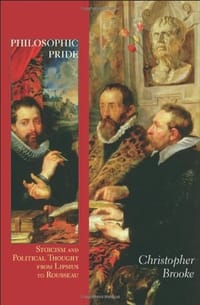
"Philosophic Pride" is the first full-scale look at the essential place of Stoicism in the foundations of modern political thought. Spanning the period from Justus Lipsius' "Politics" in 1589 to Jean-Jacques Rousseau's "Emile" in 1762, and concentrating on arguments originating from England, France, and the Netherlands, the book considers how political writers of the period engaged with the ideas of the Roman and Greek Stoics that they found in works by Cicero, Seneca, Epictetus, and Marcus Aurelius. Christopher Brooke examines key texts in their historical context, paying special attention to the history of classical scholarship and the historiography of philosophy. Brooke delves into the persisting tension between Stoicism and the tradition of Augustinian anti-Stoic criticism, which held Stoicism to be a philosophy for the proud who denied their fallen condition. Concentrating on arguments in moral psychology surrounding the foundations of human sociability and self-love, "Philosophic Pride" details how the engagement with Roman Stoicism shaped early modern political philosophy and offers significant new interpretations of Lipsius and Rousseau together with fresh perspectives on the political thought of Hugo Grotius and Thomas Hobbes. "Philosophic Pride" shows how the legacy of the Stoics played a vital role in European intellectual life in the early modern era.
Christopher Brooke is lecturer in political theory and the history of political thought in the Department of Politics and International Studies at the University of Cambridge, where he is a fellow of King's College.
 Microeconomic Foundations II
 That Tyrant, Persuasion
 The Two Greatest Ideas
 The Princeton Guide to Historical Research
 The Handbook of China's Financial System
 Leaving Academia: A Practical Guide