
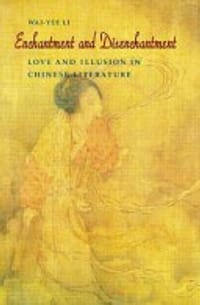
In a famous episode of the eighteenth-century masterpiece The Dream of the Red Chamber, the goddess Disenchantment introduces the hero, Pao-yü, to the splendors and dangers of the Illusory Realm of Great Void. The goddess, one of the divine women in Chinese literature who inspire contradictory impulses of attachment and detachment, tells Pao-yü that the purpose of his dream visit is "disenchantment through enchantment," or "enlightenment through love." Examining a range of genres from different periods, Wai-yee Li reveals the persistence of the dialectic embodied by the goddess: while illusion originates in love and desire, it is only through love and desire that illusion can be transcended.
Li begins by defining the context of these issues through the study of an entire poetic tradition, placing special emphasis on the role of language and of the feminine element. Then, focusing on the "dream plays" by T'ang Hsien-tsu, she turns to the late Ming, an age which discovers radical subjectivity, and goes on to explore a seventeenth-century collection of classical tales, Records of the Strange from the Liao-chai Studio by P'u Sung-ling. The latter half of the book is devoted to a thorough analysis of The Dream of the Red Chamber, the most profound treatment of the dialectic of enchantment and disenchantment, love and enlightenment, illusion and reality.
Wai-yee Li is Professor of Chinese Literature at Harvard University.
- "The genealogy of disenchantment begins at the moment of enchantment. Enchantment is the process of being drawn into another world that promises sensual and spiritual fulfillment. It is the illusion of power, of the capacity to transcend the human condition. Disenchantment is the awareness of enchant"
- "The act of telling involves distance and reflection, but there is also the danger of self-enchantment. The representation of dreams and illusions called "past life" is destined to be mere somniloquy, for final awakening is silence. 讲述固然意味着距离与反思,但同时也潜藏着自我迷醉的危险。那些被称作“前生”的梦境与幻象的再现,注定不过是梦中的低语——因为真正的觉醒,是"
- "The knowledge offered as substitute for the delusions created by feelings is then just as empty. 用以替代情执的所谓顿悟,实则同样虚妄。"
- "But formulations such as "understanding reality through illusion" and "attaining enlightenment through love" suggest that opposite, discrete moments are mediated in the direction of a higher unity, while in the Kierkegaardian sense irony mediates opposites in the interest of a higher madness. The so"
- "Perhaps this line by Yen Chi-tao, a poet also described as mad, obsessed, and burdened with excessive feelings and innocence (ch'ih), best sums up this particular authorial attitude: Lovingly I sort out my old madness "Madness" (k'uang) means, of course, not the loss of reason but the gap between th"
 Microeconomic Foundations II
 That Tyrant, Persuasion
 The Two Greatest Ideas
 The Princeton Guide to Historical Research
 The Handbook of China's Financial System
 Leaving Academia: A Practical Guide