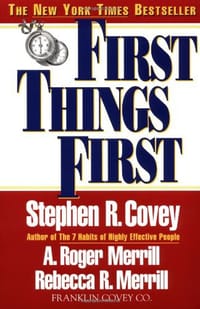
First Things First

A. Roger Merrill, Rebecca R. Merrill, Stephen R. Covey

出版社

Free Press

出版时间

1996-01-17

ISBN

9780684802039

评分

★★★★★
书籍介绍
Book Description I'm getting more done in less time, but where are the rich relationships, the inner peace, the balance, the confidence that I'm doing what matters most and doing it well? Does this nagging question haunt you, even when you feel you are being your most efficient? If so, First Things First can help you understand why so often our first things aren't first. Rather than offering you another clock, First Things First provides you with a compass, because where you're headed is more important than how fast you're going. Amazon.com What are the most important things in your life? Do they get as much care, emphasis, and time as you'd like to give them? Far from the traditional "be-more-efficient" time-management book with shortcut techniques, First Things First shows you how to look at your use of time totally differently. Using this book will help you create balance between your personal and professional responsibilities by putting first things first and acting on them. Covey teaches an organizing process that helps you categorize tasks so you focus on what is important, not merely what is urgent. First you divide tasks into these quadrants: 1.Important and Urgent (crises, deadline-driven projects) 2.Important, Not Urgent (preparation, prevention, planning, relationships) 3.Urgent, Not Important (interruptions, many pressing matters) 4.Not Urgent, Not Important (trivia, time wasters) Most people spend most of their time in quadrants 1 and 3, while quadrant 2 is where quality happens. "Doing more things faster is no substitute for doing the right things," says Covey. He points you toward the real human needs--"to live, to love, to learn, to leave a legacy"--and how to balance your time to achieve a meaningful life, not just get things done.                            --Joan Price From Publishers Weekly This is the latest time-management book from the author of The 7 Habits of Highly Effective People. From Library Journal Covey ( The Seven Habits of Highly Effective People , LJ 3/15/90) and Roger and Rebecca Merrill here create a new paradigm for taking control of busy lives. Unlike the dozens of self-help books that focus on the clock or the way people spend their time, they offer a "principle-centered" approach to time management that emphasizes what "represents our vision, values, principles, mission, conscience, direction--what we feel is important and how we lead our lives." The authors argue that central to our lives are "four needs and capacities--to live, to love, to learn, to leave a legacy." The ideas here are not only clearly explained but are reinforced by scenarios from the authors' lives and self-directed activities for the reader. Introspection and self-reflection play a larger role here than in most time management books. Highly recommended for all types of collections. Previewed in Prepub Alert, LJ 5/15/93.                           - Jane M. Kathman, Coll. of St. Benedict Lib., St. Joseph, Minn. From Booklist Time management isn't enough, say Covey and his co-authors, Roger and Rebecca Merrill. But it's an effective starting point, so first lay out your life in four quadrants labeled urgent, not urgent, important, and unimportant. That is, a task may have a deadline, but not much importance; or a task may be important, but require preparation and planning. You should stop doing what's unimportant and without urgency. Where the important and the urgent intersect is where you need to expend most of your energies. Assuming that urgency announces itself, the real question is knowing what's important, and Covey and the Merrills draw from a variety of sources to guide you toward determining just that. Much of their argument goes beyond the linear time of time management and centers on quality time; to properly prioritize and spend one's moments happily and productively, one sets goals--or principles--from which all else flows. These goals embody a perfect balance of the mental, the physical, the spiritual, and the social--that is, you need a challenging job, you need to exercise, you need a system of beliefs, and you need someone to love you. Covey, whose The Seven Habits of Highly Effective People has sold 4,000,000 copies, with the aid of the Merrills again offers common sense for those who are working like dogs and, in the bargain, living dogs' lives.                              John Mort Book Dimension : length: (cm)21                 width:(cm)14
AI导读
核心看点
  • 提供人生指南针而非时钟,强调方向比速度更重要。
  • 区分重要与紧急,聚焦第二象限以获取长期平衡。
  • 从追求效率转向追求效能,做正确的事而非正确地做事。
适合谁读
  • 感到忙碌却缺乏内心平静与平衡感的职场人士。
  • 希望从时间管理技巧进阶到人生原则管理的读者。
  • 深受《高效能人士的七个习惯》影响,寻求实践落地的读者。
读前提醒
  • 本书结构较松散,建议结合周计划工具辅助阅读与实践。
  • 部分译本存在翻译瑕疵,需耐心梳理核心逻辑脉络。
  • 重在反思生活愿景与角色平衡,而非寻找速成技巧。
读者共识
  • 时间管理领域的经典之作,理念经得起时间检验。
  • 核心观点深刻,但全书篇幅较长,部分读者嫌其冗长。
  • 帮助读者摆脱忙碌陷阱,找回生活掌控感与幸福感。

本导读基于书籍简介、目录、原文摘录、短评和书评生成,不等同于全文精读。

精彩摘录
  • "非有意地干重要的事情,等于无意识地干不重要的事情 第四代时间管理法的基础就是“重要性”模式。知道什么重要而且去做,不只应对紧迫事情,这是将首要事情放在首位的根基所在 我们从解决紧迫和重要的危机中得到了暂时的快感。然而如果事情不重要,其紧迫性就成为非常重要的因素,我们就会不由自主地处理紧急事情,且一发不可收拾。人们期望自己忙碌起来,多干活。这已经成为我们社会的地位象征——如果很忙,自己就是重要的;如果不忙,我们几乎羞于承认这一点。我们从忙忙碌碌中获得了安全感。忙忙碌碌让人充实,讨人喜欢,使人愉悦,也是不用处理我们生活中首要事情的绝好借口。 嗜急成瘾是一种自我摧残的行为,它能够暂时填补未得到满足的"
  • "我正在做的事情当中有哪些事情你们希望看到我继续做下去?哪些事情你们希望我停下来?哪些事情你们希望我开始做而我还没开始做?"
  • ""内在的不停地变成外在的,"经典著作《思考的人》的作者詹姆斯•艾伦说,"一个人的生活状态来自他的内心状态;他的思想转变成行为,而他的行为造就性格和命运。""
  • "在时间安排上,我们不断地做出选择,从生活中的重要时期到个人的片刻瞬间,莫不如此。同时我们也承受这些选择所带来的后果。"
  • "构想的威力真是难以置信!研究表明,有着未来角色形象的儿童在学校的表现要好得多,而且在处理生活中的挑战方面也更强的多。具有强烈使命感的团队和机构要大大强于缺乏构想威力的团队。按照荷兰社会学家弗雷德 波拉克说法,影响文明成功的主要因素是人民对于其未来的“集体构想”。 构想是创造性想象力的最佳显示,是人类活动的主要动力。它是超越目前现实的远见能力、是创造的能力、是发明目前没有的事物的能力、是成为更完美的自我的能力。它赋予我们能力,依据创造性想象力而生活而不是依据记忆而生活。 使命宣言: 1.代表你内心最深刻、最美好的东西。它来自于与你内心生活的紧密联系。 2.履行你独有的天赋才能。它表达了你独具特色"
  • "要从中得到最大收获,就需要全力投入—愿意检讨自己的生活、记录、动机、"首要事情"以及自己所代表的现象。"
  • "我们仅仅重视某些东西并不一定意味着会创造生活质量。当所看重的东西与主宰心情平静及高质量生活的自然规律背道而驰时,我们就是将自己的生活建立在错觉之上,注定要失败。我们不可能成为主宰自己的法则。"
  • "Basing our happiness on our ability to control everything is futile. While we do control our choice of action, we cannot control the consequences of our choices. Universal laws or principles do. Thus, we are not in control of our lives; principles are. We suggest that this idea provides key insight "
用户评论
the best book in time management
The first audio-book anyway. Visions and Missions, Roles, "Find the Q-2 Goals in each role."
1. Understanding the priority setting situation (what to do today?). 2. Purpose or goal to be achieved (to use one free hour today most effectively). 3. Available alternatives (letters, booklets, phone calls, coffee break, or conversation). 4. Proba
Our greatest joy and our greatest pain comes in our relationships with others...
Every breakthrough is a break-with, letting go. No matter how large or small our circle of influence, we could connect more deeply with our inner conscience and give light and warmth to thy world.
将时间管理作为一个课题来研究,这是没什么问题的,输出的理念也没有错误,简单来说,就是做减法,不是效率高了,就觉得事情都可以完成了,而是只做重要的事情,很对。但是这么大部头就为了说一个理念,对我来说,太没有意义了。
You know what you want, so go for it.
best book I have read this year!!!
下载
收藏