
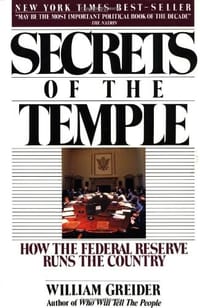
书籍介绍
This ground-breaking best-seller reveals for the first time how the mighty and mysterious Federal Reserve operates -- and how it manipulated and transformed both the American economy and the world's during the last eight crucial years. Based on extensive interviews with all the major players, Secrets of the Temple takes us inside the government institution that is in some ways more secretive than the CIA and more powerful than the President or Congress.
Excerpt. © Reprinted by permission. All rights reserved.
Chapter 1
THE CHOICE OF WALL STREET
In the American system, citizens were taught that the transfer of political power accompanied elections, formal events when citizens made orderly choices about who shall govern. Very few Americans, therefore, understood that the transfer of power might also occur, more subtly, without elections. Even the President did not seem to grasp this possibility, until too late. He would remain in office, surrounded still by the aura of presidential authority, but he was no longer fully in control of his government.
The American system depended upon deeper transactions than elections. It provided another mechanism of government, beyond the reach of the popular vote, one that managed the continuing conflicts of democratic capitalism, the natural tension between those two words, "democracy" and "capitalism." It was part of the national government, yet deliberately set outside the electoral process, insulated from the control of mere politicians. Indeed, it had the power to resist the random passions of popular will and even to discipline the society at large. This other structure of American governance coexisted with the elected one, shared power with Congress and the President, and collaborated with them. In some circumstances, it opposed them and thwarted them.
Citizens were taught that its activities were mechanical and nonpolitical, unaffected by the self-interested pressures of competing economic groups, and its pervasive influence over American life was largely ignored by the continuing political debate. Its decisions and internal disputes and the large consequences that flowed from them remained remote and indistinct, submerged beneath the visible politics of the nation. The details of its actions were presumed to be too esoteric for ordinary citizens to understand.
The Federal Reserve System was the crucial anomaly at the very core of representative democracy, an uncomfortable contradiction with the civic mythology of self-government. Yet the American system accepted the inconsistency. The community of elected politicians acquiesced to its power. The private economy responded to its direction. Private capital depended on it for protection. The governors of the Federal Reserve decided the largest questions of the political economy, including who shall prosper and who shall fail, yet their role remained opaque and mysterious. The Federal Reserve was shielded from scrutiny partly by its own official secrecy, but also by the curious ignorance of the American public.
It was in midsummer of 1979 when this competing reality of the American system confronted the President of the United States and discreetly compelled him to yield. Jimmy Carter, in the third year of his Presidency, was engulfed by popular discontent and declining authority. The public that first embraced the simple virtues Carter expressed in his gentle Georgia accent -- earnest striving and honest, open government -- was by then overwhelmingly disenchanted with his management. Despite its accomplishments, the Carter Presidency had come to stand for confusion and inconsistency. His stature was diminished by a series of ill events, from failed legislation to revolution in Iran. A Gallup poll asked Democrats whom they would prefer as their party's nominee in 1980 and they chose Senator Edward M. Kennedy of Massachusetts over the incumbent President, 66 to 30 percent.
In early July, Jimmy Carter set out to restore his popular support. The political crisis had been developing for many months but was now dramatized by the President's own behavior. He scheduled an address to the nation on energy problems, then abruptly canceled it and, somewhat mysteriously, withdrew from the daily business of the White House. He and his closest advisers gathered in private at Camp David, the presidential retreat in the Maryland mountains. For ten days, the President remained there in isolation, conducting earnest seminars on what had gone wrong with the Carter Presidency and, indeed, what had gone wrong with America itself.
A stream of influential visitors was summoned to the President's lodge to offer advice. They were diverse opinion leaders from politics, education, religion and other realms, and their talk skipped across the landscape of American life. In his methodical manner, Carter filled a notebook with their comments. Each day, the press speculated extravagantly on what the President intended to do.
On Saturday, July 14, the
用户评论
全面阐述了美联储,货币政策,宏观经济政策的来龙去脉,利弊,争议,历史大背景(阴谋论在这种巨著前显得像城乡结合部染一头黄毛的非主流小弟)。唯一缺点是有点啰嗦
Simon & Schuster的其他书籍查看全部
 Elon Musk
 Principles for Dealing with the Changing World Order
 I Would Leave Me If I Could
 White Ivy
 Rage
Rage Think Like a Monk
下载
收藏