
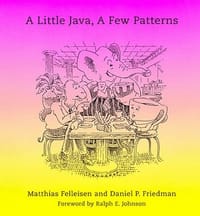
A Little Java, A Few Patterns
出版时间
1997-12-19
ISBN
9780262561150
评分
★★★★★
书籍介绍
这本书最特别之处,在于它把 Java 当作一种函数式语言来教。当大多数编程书把「对象」当作世界的核心时,作者却让 new 一个对象变得像构造一个列表那样层层嵌套——一串 new Onion(new Lamb(new Skewer())) 读下来,读者会忽然察觉 class、interface、object 之间那层一直模糊的关系。全书围绕 visitor pattern 徐徐展开,不是告诉你「这是什么模式」,而是让你亲眼看着它如何从「数据类型变种越来越多、每次都要改代码」的困境里自然长出来。它适合那些不满足于「会用 Java」,而想理解面向对象与函数式究竟如何交汇的人。当然,也有人觉得它繁琐、最后一章晦涩,但正是这种较真,让读完的人对「设计」二字有了不同的体感。
AI导读
核心看点
- 用Java子集讲解函数式编程思想
- 循序渐进推导访问者模式原理
- 一问一答式引导理解OOP概念
读者共识
- 讲解清晰,自然引出设计模式
- 将Java当作函数式语言来玩
- 示例简练,适合入门学习Java
精彩摘录
- "And a third? 21 Here's one more: new Onion( new Lamb( new Onion( new Skewer()))). Are there only Onions on this Shish: new Skewer()? 22 true, because there is neither Lamb nor Tomato on new Skewer()"
- "If Java had parametric polymorphism for methods, no downward cast would be necessary for our visitors (Martin Odersky and Philip Wadler, Pizza into Java: Translating Theory into Practice, Conference Record on Principles of Programming Languages, 146-159. Paris, 1997)"
- "Does that mean that anybody can write yy.p = new Bot() and thus change a pieman like yy? 36 No, because yy's type is Peiman, p isn't available. Only addTop, remTop, substTop, and occTop are visible. Isn't it good that we didn't include p in Peiman? 37 Yes, with this trick we can prevent others from "
用户评论
沒見過把 OOP 當 FP 玩兒的,但非常有趣,看他循序漸進,去到某處就有似曾相識的感覺,慢慢就更懂了 class interface object 之間的關係,最後掌握 visitor pattern。有意思,但說這是 Java 精粹的話,不知道是在黑 Java 還是鼓勵讀者研究 FP 呢,反正我看完對 FP 更感興趣些。王垠推薦就看了,不錯。
看完了,把OOP当成FP来玩,佩服。至于实用性?看这书的,睡在乎?
visitor模式很漂亮!
示例简练,可用作学习Java的第一本书
visitor pattern讲透了;最后用interface实现的Y组合字还没太看懂
看了两章,看不下去了。。。
这是一本不浮躁的书,从减少模版代码的角度挺有意义的
牵强的用scheme的思路讲了讲visitor pattern, 但是考虑成书时间,彼时design patterns刚初登舞台,所以开阔思路可以,visitor pattern本身应用是很窄的
抽象,框架。出现accept方法的时候,惊呆了
有点啰嗦,主要就是讲了一个visitor pattern,还是有点意思的,虽然工作中几乎不可能这么写代码。书写于1997年,如果现在用范型重写一遍示例代码应该会更优雅一点。
一刷后,有点不明觉历。特别是第十章,不知道主要是说什么,看起来是出现了对状态的改变。这本书对类、继承的描述很特别。总体值得一看,过几天二刷……
The MIT Press的其他书籍查看全部
 Essentials of Compilation
 Make it Clear
 An Introduction to Statistical Genetic Data Analysis
 Cloud Computing for Machine Learning and Cognitive Applications
 Introduction to Computation and Programming Using Python (2/e)
 How Not to Network a Nation
下载
收藏