
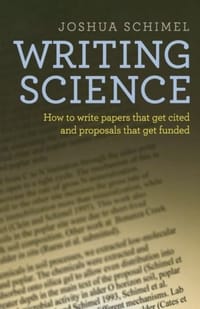
书籍介绍
这本书最锋利处,在于它干脆拆掉了「科学写作」与「大众写作」之间的墙。作者直言:科学只是英语的一种方言,而非一门独立语言,因此好论文的本质不是堆砌术语,而是让非专业人士也能听懂。它把论文重新拆解为开场、挑战、行动、解决四段式,用讲故事的结构取代刻板的IMRAD框架——这个主张在读者中褒贬分明:有人十星力荐、称其为博士新生必读,也有人因学科差异(如经济学)觉得并不适用。更耐人寻味的是,作者将「反复改写」视为一种必经的痛感,认为正是在这种痛苦的重写中,思维与表达同时趋于清晰。它适合那些不满足于「把论文发出来」、而渴望「被真正理解与引用」的写作者。
作者简介
I grew up in New York City, loving the outdoors but thinking I wanted to be a chemist. I only discovered soil science after I graduated from College and was working as a technician in an ecosystem ecology lab. I'd never liked biology but I'd never realized that it could let you do chemistry with a view out the window that wasn't looking over the East River to Brooklyn, but over Toolik Lake and the arctic cottongrass south to the Brooks Range, and the world. It's even more fun when the snow's flying and the mosquitoes are not.
I became a Professor, first at the University of Alaska Fairbanks, and now at UC Santa Barbara, as well as journal editor, Program Chair, and other jobs that need doing to keep science and Academe running. But the real fun in being a scientist will always be the rush of a new data set. There is nothing like the "Huh!?" of a "What an Idiot" moment, when something that had been puzzling suddenly becomes clear, leaving me wondering how I'd been such an idiot not to have seen it before.
Somewhere along the line I became interested in communication and how we tell the story to explain our results; marrying an aspiring writer didn't hurt either. I put together my first workshop on writing science when I was spending the summer in a lab in Montpellier, France; that morphed into a full-blown graduate class back in Santa Barbara. I started writing up notes from class and thought I might flesh them out in a few columns for the Bulletin of the Ecological Society of America. Everything was going smoothly until the "What an Idiot" moment: I wasn't writing a few essays--I was writing a book. Huh.
AI导读
核心看点
- 科学家即职业作家,写作是科研核心技能
- 以故事结构重构论文,填补读者知识缺口
- 成功在于影响力与引用,而非单纯发表数量
读者共识
- 颠覆传统写作观念,强调讲故事的重要性
- 内容深刻但门槛较高,不适合纯入门新手
- 被公认为提升科研写作影响力的必读经典
精彩摘录
- "The dark, dirty secret of this book is that it is really all about writing for the public. "Science" isn't a different language than "English". It's a dialect, and everything I've said has been about how to write science in a way that makes it closer to common English. Every suggestion has been at t"
- "1. As a scientist, you are a professional writer."
- "2. Success is defined not by the number of pages you have in print but their influence. You succeed when your peers understand your work and use it to motivate their own."
- "3. I agree with Montgomery. Often, the process of structuring your thoughts to communicate them allows you to test and refine those thoughts. As you focus on writing clearly, you force yourself to think more clearly. Improving your writing will help you become successful, both because it allows you "
- "4. Writing can be a painful process of rewriting, rewriting, and more rewriting until your work gets good enough to send off. An artist never completes a work -- they merely let it go. This rewriting cycle develops both your writing and your thinking, moving both towards clarity and power."
- "Writing can be a painful process of rewriting, rewriting, and more rewrting until your work gets good enough to send off.... This rewrting cycle develops both your writing and and your thinking, moving both toward clarity and power.... If you are going to be a successul writer, learn to embrace the "
- "Our tendency is to tell people the facts. First, though, they must realize they need them. We make a good story by identifying the knowledge gap we will fill. You frame a knowledge gap by using what is known to identify the boundaries of that knowledge. It’s like framing a window — build the structu"
- "The second important exercise is to analyze the writing in published papers. How did the authors tell their story? did it work? was it clear? how could you improve the writing ?"
用户评论
这本书的着重点在于如何 通过讲故事的方法写好论文,而不拘泥于遣词造句,跟传统的IMRAD的论文结构不同,作者重新使用opening、challenge、action和resolution来定义论文结构,读完之后对科研和论文写作有了重新的认识,也破除了很多常识性的错误。但是书中选取的例子专业术语过多,相对来说,对读者自己概括的能力有所要求。make the readers job easy!问题导向!knowledge & information!get cited!
非常棒的科研论文写作教程,作者将自己的理论也几乎完美地应用到了本书的书写中。清晰的表达,典型的举例,简明的结构使得本书平易近人,宛如在课堂上教授内容,活灵活现。作者的核心观点就是要写出好的科研故事,赢取更多的引用率以及提高申请基金的成功率,这就务使科研工作者需要相机行事,万不能扎进自己的世界到头来却又辜负自己的辛勤付出。一言以蔽之,写作,尤其在当下,都是需要抓取读者注意力从而提高自身的知名度。作者教给读者的其实是表达和叙述的规范,如此才能尽量减少他人的麻烦,转而使得自己获得青睐。无论采取何种结构布局,进行何种段落缀联,都是为了文章的可阅读性更强,让工作成果被更多人正确无误的知晓。顺带一提,该书每一章的练习都相当适合用在修改论文的时候提醒自己。
story telling verb communication, 挺好的, 比较专业, 策略性指导
书是好书,但是真的太难了...一般国内读硕士的人就别读了...真心学不来
如果有6星的话我会给6星的。每一篇文章都是讲故事的想法很好。具体的如何写文章的细节也让人很有收获。"You might survive by publishing a lot of papers, but you will succeed only by good ones"
看完这本书,惊为天人。没当改论文改不下去的时候就翻开读一读,大有启发。至今已经读第三遍了。
非常细致的一本书,每个技巧都附有例子和对比,适合精读
神作...挺高階的guide了,沒有idea還是爛文章呀哈哈…讀完最大的感受:我知道但我辦不到(
「I think people use fuzzy verbs when they are afraid that if they make strong statements, someone may challenge them or they may be wrong...being nebulous and timid to avoid being wrong ensures that your work will contribute little」——深以為然lol
受益匪浅
把叙述的技巧用到论文里

Oxford University Press的其他书籍查看全部
 The Oxford Handbook of Experimental Syntax (Oxford Handbooks)
 The Fasces
 The Primacy of Doubt
 Landscape and Space
 Future Morality
 Figurines
下载
收藏