
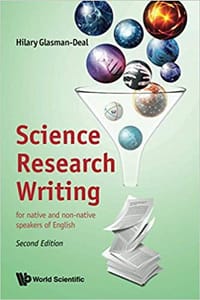
Science Research Writing (2/e)
出版时间
2020-11-01
ISBN
9781786347848
评分
★★★★★
书籍介绍
这不是一本教你套用模板的学术写作手册,而是一把拆解科研论文内在逻辑的钥匙。作者以'逆向工程'法著称:不告诉你'该怎么写',而是带你反过来拆解优秀论文'为什么这样写',从而理解每一处结构安排背后的读者心理。书中最耐人寻味的洞见在于——语言本身具有塑造认知的力量:你用'两条曲线高度相似'还是'显著不同'来描述同一张图,读者就会真的'看见'相似或不同。结果的重要性无法靠语气或强调符号传递,只能靠详略取舍来暗示;冠词a/the的选用、情态动词的强弱,都在不动声色地替你'站队'。它尤其适合非英语母国的科研初学者:在掌握框架之余,学会从读者视角审视每一个句子,把'术'升华为'道'。
作者简介
Hilary Glasman-Deal teaches academic STEMM communication at Imperial College London. Her primary focus is on research writing for native and non-native speaking doctoral students, postdocs and academic staff. She consults on scientific research publication at the highest level in all areas of STEMM, working with researchers to communicate complex content effectively across a range of fast-changing communication platforms. Hilary also delivers workshops and short courses on writing for journal publication around the world.
AI导读
核心看点
- 逆向工程法拆解写作模型
- 从读者视角重构论文逻辑
- 详解STEMM各部分写作规范
读者共识
- 被誉为科研写作圣经
- 强调写作之道而非仅术
- 示例直观且建议细致
精彩摘录
- "If you describe all your results in equal detail they will seem to have the same level of importance. This is unlikely to be the case: some of your results are probably more significant than others, some are typical, and some are key results whereas others may be of more peripheral interest. However"
- "There are some grammar issues that are worth noting. When you use key words in constructing the title, be careful about creating complex compound nouns. The conciseness of a compound noun is very tempting for non-native writers and English has a high level of tolerance for such nouns, but make sure "
- "Use of 'a' and 'the': Use THE if or when you and your reader both know which thing/person you mean. e.g. I had a cheese sandwich and an apple for lunch. The sandwich was fine but the apple had a worm in it. Use THE if there is only one possible referent. e.g. Government policy is committed to protec"
- "The language you use to describe your results has as much power as the tables and graphs themselves, perhaps even more. Look at the two curves in the figure below:"
- "When you comment on this figure, if you write As can be seen in the figure, the two curves are very similar, the reader will focus on the similarity between the curves, and they will therefore seem similar. However, if you write As can be seen in the figure, the two curves are noticeably different, "
- "and you can use more than one in a sentence, depending on how ‘weak’ you want your claim to be — but be careful; if you add too many, the sentence may not mean very much at all: The evidence points to the possibility that in many cases, x can contribute to certain types of y."
- "Make sure that you understand the difference between the explanation of a result (why it occurred as it did), the evaluation of a result (what the numbers mean) and the implication of a result (what the result suggests or implies)."
- "Saying what your results are is the central function of the Results section; talking about what they mean is the central function of the Discussion."
用户评论
我还没读 请问和那本for non native的区别很大吗 纠结买不买
一周读完!
学术写作,强烈推荐!
非常好的工具书!虽然已经有很多senior researchers 给出了如何进行学术写作的tips,但是这本书在框架的基础上提供了更多细致的建议以及更为直观的示例。这对于懵懂的junior来说非常重要!唯一可惜的是这本书是关于自然学科的学术写作,norm和社科类的还是有很多差别,不过我仍旧学到了很多。
求书
收藏