
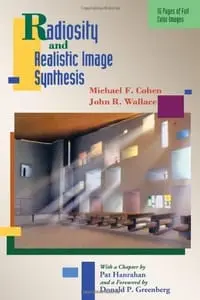
内容简介
The goal of image synthesis is to create, using the computer, a visual experience that is identical to what a viewer would experience when viewing a real environment. Radiosity and Realistic Image Synthesis offers the first comprehensive look at the radiosity method for image synthesis and the tools required to approach this elusive goal.
Basic concepts and mathematical fundamentals underlying image synthesis and radiosity algorithms are covered thoroughly. (A basic knowledge of undergraduate calculus is assumed). The algorithms that have been developed to implement the radiosity method ranging from environment subdivision to final display are discussed. Successes and difficulties in implementing and using these algorithms are highlighted. Extensions to the basic radiosity method to include glossy surfaces, fog or smoke, and realistic light sources are also described.
There are 16 pages of full colour images and over 100 illustrations to explain the development and show the results of the radiosity method. Results of applications of this new technology from a variety of fields are also included.
Michael Cohen has worked in the area of realistic image synthesis since 1983 and was instrumental in the development of the radiosity method. He is currently an assistant professor of computer science at Princeton University. John Wallace is a software engineer at 3D/EYE, Inc., where he is the project leader for the development of Hewlett-Packard's ATRCore radiosity and ray tra...
Morgan Kaufmann的其他书籍查看全部
 《Freemium Economics》
 《Computer Organization and Design, Fifth Edition》
 《Design Research Through Practice》
 《Computer Networks, Fifth Edition》
 《TCP/IP Sockets in Java, Second Edition》
 《Sketching User Experiences》