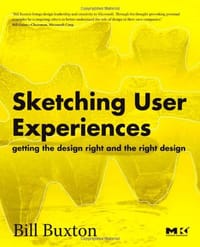
Sketching User Experiences

Bill Buxton

出版时间

2007-04-11

ISBN

9780123740373

评分

★★★★★
书籍介绍
Bill Buxton and I share a common belief that design leadership together with technical leadership drives innovation. Sketching, prototyping, and design are essential parts of the process we use to create new products. Bill Buxton brings design leadership and creativity to Microsoft. Through his thought-provoking personal examples he is inspiring others to better understand the role of design in their own companies--Bill Gates, Chairman, Microsoft "Informed design is essential." While it might seem that Bill Buxton is exaggerating or kidding with this bold assertion, neither is the case. In an impeccably argued and sumptuously illustrated book, design star Buxton convinces us that design simply must be integrated into the heart of business--Roger Martin, Dean, Rotman School of Management, University of Toronto Design is explained, with the means and manner for successes and failures illuminated by engaging stories, true examples and personal anecdotes. In Sketching User Experiences, Bill Buxton clarifies the processes and skills of design from sketching to experience modeling, in a lively and informative style that is rich with stories and full of his own heart and enthusiasm. At the start we are lost in mountain snows and northern seas, but by the end we are equipped with a deep understanding of the tools of creative design.--Bill Moggridge, Cofounder of IDEO and author of Designing Interactions "Like any secret society, the design community has its strange rituals and initiation procedures. Bill opens up the mysteries of the magical process of design, taking us through a land in which story-telling, orange squeezers, the Wizard of Oz, I-pods, avalanche avoidance, bicycle suspension sketching, and faking it are all points on the design pilgrim's journey. There are lots of ideas and techniques in this book to feed good design and transform the way we think about creating useful stuff". -Peter Gabriel I love this book. There are very few resources available that see across and through all of the disciplines involved in developing great experiences. This is complex stuff and Buxton's work is both informed and insightful. He shares the work in an intimate manner that engages the reader and you will find yourself nodding with agreement, and smiling at the poignant relevance of his examples.--Alistair Hamilton, Symbol Technologies, NY Books that have proposed bringing design into HCI are aplenty, though books that propose bringing software in to Design less common. Nevertheless, Bill manages to skilfully steer a course between the excesses of the two approaches and offers something truly in-between. It could be a real boon to the innovation business by bringing the best of both worlds: design and HCI. --Richard Harper, Microsoft Research, Cambridge There is almost a fervor in the way that new products, with their rich and dynamic interfaces, are being released to the public-typically promising to make lives easier, solve the most difficult of problems, and maybe even make the world a better place. The reality is that few survive, much less deliver on their promise. The folly? An absence of design, and an over-reliance on technology alone as the solution. We need design. But design as described here depends on different skillsets-each essential, but on their own, none sufficient. In this rich ecology, designers are faced with new challenges-challenges that build on, rather than replace, existing skills and practice. Sketching User Experiences approaches design and design thinking as something distinct that needs to be better understood-by both designers and the people with whom they need to work- in order to achieve success with new products and systems. So while the focus is on design, the approach is holistic. Hence, the book speaks to designers, usability specialists, the HCI community, product managers, and business executives. There is an emphasis on balancing the back-end concern with usability and engineering excellence (getting the design right) with an up-front investment in sketching and ideation (getting the right design). Overall, the objective is to build the notion of informed design: molding emerging technology into a form that serves our society and reflects its values. Grounded in both practice and scientific research, Bill Buxton's engaging work aims to spark the imagination while encouraging the use of new techniques, breathing new life into user experience design. . Covers sketching and early prototyping design methods suitable for dynamic product capabilities: cell phones that communicate with each other and other embedded systems, "smart" appliances, and things you only imagine in your dreams; . Thorough coverage of the design sketching method which helps easily build experience prototypes-without the effort of engineering prototypes which are difficult to abandon; . Reaches out to a range of designers, including user interface designers, industrial designers, softwa
AI导读
核心看点
  • 强调手绘草图是探索设计可能性的核心工具
  • 阐述设计思维应融入商业战略与工程流程
  • 通过大量案例解析从概念生成到原型迭代过程
适合谁读
  • 交互设计与用户体验领域的初学者及入门者
  • 希望提升产品沟通效率与创意发散能力的从业者
  • 对设计思维如何驱动创新感兴趣的非设计背景人员
读前提醒
  • 部分案例略显陈旧,需结合当下技术背景辩证阅读
  • 建议配合实际项目练习手绘,以深化对草图价值的理解
  • 前半部分重理论铺垫,后半部分重方法实操,需耐心
读者共识
  • 作为UX经典入门书,脉络清晰且图文并茂易读
  • 对无设计背景者极友好,但对资深设计师启发有限
  • 虽部分观点显老生常谈,但设计哲学依然具有启发性

本导读基于书籍简介、目录、原文摘录、短评和书评生成,不等同于全文精读。

精彩摘录
  • "他特别强调公司要重归原有轨道,却迎合客户的核心需求;同时指出,正是由于片面追求大而全,忽视了客户的真正需求,才导致苹果公司在市场竞争中败北。他还表明,公司已有新的突破,推出了原创的苹果操作系统和硬件设计,并且他将把工业设计置于苹果开拓策略的核心位置。"
  • "彼时,苹果公司资金运转问题严重,这就意味着他所作出的每个决策都必须要坚定可靠,而且要能立竿见影。 1.是产品设计拯救了苹果;2.现有团队造就了设计创新;3.管理层眼光决定成败;4.保持势头,强劲发展;5.失败在所难免;6.失败乃成功之匙;7.产品外观式样、风格的设计非常成功;8.工业设计和用户交互设计两者几乎没有关联; 产品版本发布次数越多,累计成本就会越高。 首先,不断推出新版本,那么系统就趋向复杂,产品可塑性就会降低,增值或修改成本相应提高。 第二,产品一旦成熟,现有用户达到一定数量。此时,开发商对产品的改进将受到用户群体的制约。 第三,当产品日益成熟,基本功能业已完善,客户群体也相应稳定"
  • "把设计看成漏斗, 并在新增概念和概念精简(概念生成, 受控整合), 并不断迭代. 设计即折中"
  • "Humans create their cognitive powers by creating the environments in which they exercise those powers. At present, so few of us have taken the time to study these environments seriously as organizers of cogni- tive activity that we have little sense of their role in the construction of thought. (Hut"
  • "设计即选择,其中有两个地方可以为创造性提供空间: 1.在列举各种迥然不同的设计草案以供选择时可以表现出的创造性; 2.在定义选择的标准或准则时可以表现出的创造性"
  • "The only way to engineer the future tomorrow is to have lived in it yesterday."
  • "长远来看,“稳”比“险”更加可怕。"
  • "任何奶牛都不可能总是有奶可挤"
用户评论
需要仔细研读……TD;DR carefully
没有看完,观点可能略片面。可以确定的是这本书是写给完全没有设计背景的人看的。sketching在设计领域可以说是一件非常理所当然的事情,这本书花了很大的笔墨写sketching的重要性,还有很多平平凑凑,零零散散的sketching advice for non-designer。 我表示,作为一个有设计背景的人,收获不是很大。
项目表和参考书
前半部分讲什么是交互,后半部分介绍具体的方法
貌似比对读中文版的时候脉络清晰了,也是很实用的对设计过程的反思
现在看来书有些老,尤其第二部分的例子,但一些用户体验的研究方法现在仍然适用,就是初级了些。目前用户体验概念和基本方法深入人心,所以本书内容显得拖沓和老生常谈了。前半部分将理论后半部分讲实际操作。可能自己过了那个时期了吧,读得不来电,更适合初学者,对概念和方法扫盲有作用。
好几个老师推荐过,但是我个人读的也没什么感受。。可能水平不到吧
得练
入门读物 简单易懂但是并没有提及很多更新的值得争议的问题维度
下载
收藏