
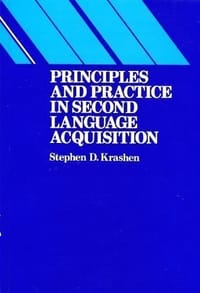
书籍介绍
这是一本能让人重新审视自己多年英语学习方式的书。许多读者读完后的第一反应是'颠覆'——原来语法背诵、反复纠错、逼着开口,未必是通往流利的路,甚至可能适得其反。作者的核心主张朴素却反直觉:语言不是'练'出来的,而是'习得'出来的,关键在于大量可理解性输入(i+1)——材料要略高于当前水平、且是自己真正感兴趣的内容,同时把焦虑压到最低。书中最具启发性的概念包括'习得与学习的区别'、'情感过滤假说'以及'监督者'现象:那些时刻自我检查语法的'过度监督者'反而说得磕磕绊绊,而凭语感自然输出的'监督不足者'更接近平流利。它不适合寻找速成技巧或考试套路的人,却适合愿意从'为什么学了这么多年还是说不出口'这个根本问题出发、重新搭建学习逻辑的读者。
AI导读
核心看点
- 提出可理解性输入i+1理论
- 强调情感过滤低下的学习环境
- 区分语言习得与有意识学习
读者共识
- 颠覆传统填鸭式教学模式
- 多读多听兴趣材料最有效
- 被读者誉为改变学习的神书
精彩摘录
- "The solution to our problems in language teaching lies not in expensive equipment, exotic methods, sophisticated linguistic analyses, or new laboratories, but in full utilization of what we already have, speakers of the languages using them for real communication. I will also conclude that the best "
- "What current theory implies, quite simply, is that language acquisition, first or second, occurs only when comprehension of real messages occurs, and when the acquirer is not "on the defensive", to use Stevick's apt phrase. Language acquisition does not require extensive use of conscious grammatical"
- "The "best methods" according to comparative research studies (comparing methods A and B, as described earlier) appear to be "input methods", those methods that focus on supplying comprehensible input in pressure-free situations."
- "In workshops and mini-conferences, we no longer see presentations on fine points of grammar, or on types of substitution drill. "Ideas that work" are ideas about role-playing, using the newspaper as a teaching aid, socio-drama, etc. Moreover, newer methodology has, as a primary goal, the lowering of"
- "(i) Monitor Over-users. These are people who attempt to Monitor all the time, performers who are constantly checking their output with their conscious knowledge of the second language. As a result, such performers may speak hesitantly, often self-correct in the middle of utterances, and are so conce"
- "(ii) Monitor under-users. These are performers who have not learned, or if they have learned, prefer not to use their conscious knowledge, even when conditions allow it. Underusers are typically uninfluenced by error correction, can self-correct only by using a "feel" for correctness (e.g. "it sound"
- "(iii) The optimal Monitor user. Our pedagogical goal is to produce optimal users, performers who use the Monitor when it is appropriate and when it does not interfere with communication. Many optimal users will not use grammar in ordinary conversation, where it might interfere. (Some very skilled pe"
- "I am not asking practitioners or materials developers to follow all of the implications of theory blindly. My hope is only that our results will be considered as another source of ideas and input to methods and materials, in partnership with conclusions reached by practitioners themselves from their"
用户评论
Not so relevant
Effective input for language acquisition should be comprehensible, interesting/relevant, not grammatically sequenced, in a large quantity and received at a low affective filter level.
一本非常专业的语言学著作,对于外语学习者来说,里面的几个语言学习假说都非常有启发。比如i+1可理解性输入、情感过滤,另外还有学得和习得的区别。在这个基础上可以摸索出一套适合自己的语言学习方法。
我以为是2000年左右的书。80年代的理论真是先进。
重视input遍地grammar的论点的确让人印象深刻
google scholar引用也很多,但毕竟是40年前提出的理论,也许有新的理论和研究。非二语教学研究者,暂不深究。
我的浅见是日常交流可以通过comprehensive input潜意识地加强,深入到appreciation和precise 表达就需要有意识地训练了
原版还是要继续读,美剧还是要继续看。。
二语习得神作,真的是改变外语学习的书!
多听多读有趣的可理解输入(i+1)!
这才叫真!爽!文!一口气看完~ @2021-03-20 10:15:58
神书。继刻意练习之后我的第二本神书。
2年前我偶然间刷到一个座机画质的krashen演讲。讲到习得语言的唯一方法是comprehensible iput。唯一方法。逻辑非常严谨。
阅读是极好的输入方法。
同时这个结论也是颠覆性的:我所经历的中学和大学教育的完形填空题,阅读理解题,选择题,老师上课讲的各种词组,全是无效或者低效练习。
这本书就是那个视频的完整版。
确实很学术!需要根据自己目的寻找有用信息。
* Looking for comprehensive materials (low filter level) 也就是说练习素材不要分少儿版,进阶版,就按照最真实日常的语料来
* Off the defensive, 这我也想明白了,觉得学生不一定会的问题就别问他了(更何况是觉得他一定不会的)咱也是做学生的,这感受咱也懂!(但是每个老师都会有点提问欲,给自己找点存在感?)
* Materials / topics should be relevant and interesting
* Not grammatically sequenced 先理解意思,再教语法
Elsevier的其他书籍查看全部
 Anatomy Trains
 Vehicle Handling Dynamics
 The Language of Medicine (10th Edition)
 Biohydrogen
 23rd European Symposium on Computer Aided Process Engineering
下载
收藏