
书籍介绍
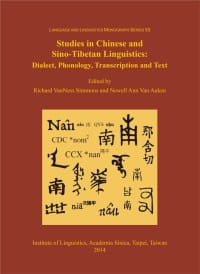
This volume has been compiled as a tribute to a scholar who has devoted his prodigiously productive career to the study of Chinese and Sino-Tibetan linguistics: W. South Coblin. To honor this man whose depth and range of scholarly interests and accomplishments are nothing short of awe-inspiring, and whose influence on the field is broad and powerful, on the occasion of his seventieth birthday we have gathered together a collection of studies that speak to those interests in various ways and that also provide new and diverse contributions to the field.
South Coblin (known in Chinese as Kē Wèinán 柯蔚南) has exerted a profound impact on the field of Chinese and Sino-Tibetan linguistics as a researcher, teacher, mentor, and colleague. His career thus far has spanned over four decades, and his research has touched upon areas as varied as Sino-Tibetan comparative and historical linguistics, Chinese historical phonology, Chinese historical and comparative dialectology, Classical Chinese grammar, Old Tibetan, the language of early Chinese vernacular texts, the history and development of Chinese koines and pre-modern Mandarin, Chinese transcriptions in 'Phags-pa script, and most recently, in Korean. He has written groundbreaking and seminal studies in all of these fields, and many of his published works have become essential references. At present writing, he is author of eleven monographs and over eighty articles and book chapters, and these numbers will surely continue to grow. After this introduction appears a brief biography that gives an overview of South Coblin’s scholarly career and traces the trajectory of development of his many and various interests and projects, and this in turn is followed by a complete bibliography of his publications to date.
Among the twenty-three contributors to this volume are South Coblin’s graduate school classmates, colleagues and peers in the field, and students and others he has mentored. In gathering the papers we endeavored to assemble a selection of research that reflects the diversity of South’s scholarship and that engages with his scholarly interests. The resulting compilation comprises twenty-two papers, which have been arranged topically into five sections: Chinese historical linguistics, Chinese dialects, Tibetan and Tibeto-Burman, language contact and transcription, and texts and written Chinese. Each section corresponds to an area in which South Coblin himself has engaged in research, and thus the collection as a whole reflects the breadth of his scholarship. Many papers are at the forefront of their respective fields, and build on South’s earlier work to arrive at significant new conclusions.
The opening section of this volume, “Chinese Historical Linguistics,” represents the area in which South Coblin began his scholarly career, and the first paper was written by the late Professor Jerry Norman, the scholar who perhaps had the deepest influence on his scholarly work. Norman’s “A Model for Chinese Dialect Evolution” is a distillation of ideas he developed over the years, many in conversations with South, and provides an alternative model for the comparative study of Chinese dialects, a model that we anticipate will ultimately supersede and replace the conventional approach of relying primarily on the phonological categories of the Qièyùn 切韻. Norman outlines two historical stages of Chinese, Common Dialectal Chinese (CDC) and Early Chinese (EC), which he developed using a strictly comparative approach based entirely on observable and documented dialect data. In his paper, he deliberately eschews the incorporation of distinctions supported only by written evidence, which might be artifacts of the literary tradition, and without basis in the actual spoken dialects. He intended that CDC and EC would provide an objectively realistic framework for understanding Chinese linguistic evolution and the phonological development of the Chinese dialects, one from which the modern dialectal forms of Chinese could be easily and naturally derived. Jerry Norman had discussed many of the details of this work with South Coblin, and thus decided to contribute it to this volume as a tribute to his close friend. He sent the final version to the editors just twelve days before his death on July 7, 2012.
The next two papers in this section address other aspects of Chinese language history. Ho Dah-an’s study, “Phonological Problems in Imperial Naming Taboos” (史諱中的音韻問題) presents an examination of Chén Yuán’s 陳垣 1928 Examples of Imperial Naming Taboos 史諱舉例 and, following a brief critique, explores the issue of taboo names and their relationship to Chinese phonological history. Ho’s discussion underscores the importance of historical phonology in any examination of issues bearing on Chinese linguistic history. Through a demonstration of the ways in which changes in the language affect the particularities of which graphs were taboo at different periods, Ho shows that once we obtain a clear und
用户评论
多为大师之作。可惜水平不够,不能完全读懂。
下载
收藏