
书籍介绍
An Introduction to
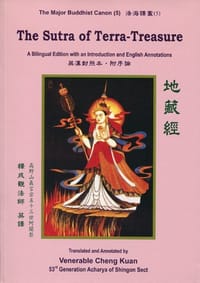
The Sutra of Terra-Treasure
I. The meaning of “Terra-Treasure Pusa”
“Terra-Treasure” in the original Sanskrit is “Ksiti-garbha.” Due to the difficulty in pronunciation, as well as for easy comprehension and ready absorption of the word for the Chinese reader, the translator in the Tang Dynasty (7th century) ingeniously chose to translate the name by meaning rather than by sound, and so he translated it as “Di-Dzang” (meaning “Earth-Treasure” or “Terra-Treasure”), which is promptly meaningful to the Chinese people. And the name of “Di-Dzang” has been adopted and become a household term in the Chinese language. And, furthermore, ever since that time, through history, this Sutra has become one of the most popular, most powerful and most read and chanted Sutra, in the midst of hundreds of Mahayana Holy Scriptures. “Terra” means Earth or Ground, but here it esoterically works as a metaphor for the Ground of Mind, or the Mental Ground. And “the Mental Ground” now is linked to the most predominant principium both in ’Chan Buddhism specifically, and in Mahayana Buddhism in general; that is, the Buddha Nature. And so we are cognizant that the Mental Ground implies the Buddha Nature which all Multibeings share in common; and this is the underlying Tenet, the most profound and majestic import in Mahayana Buddhism; without it, the edifice of Mahayana would be impossible.
Hence, “Terra-Treasure” signifies Buddha Nature in that the Mind (or Heart) is precious, for it contains and can generate all the Treasure just like the Ground or the Earth in its being able to hold (or store) and produce all the treasurable things, such as minerals, gems and plants; and that the Mind is so capacious that it could accommodate everything, just like the Ground, capable of accommodating everything equally without discrimination, be it fair or foul.
As for the word “Pusa,” again, originally in the Sanskrit it is “Bodhisattva,” the Sainthood in Buddhism next in rank to the Buddha. [Pusa, pronounced as ´poo·sa] Here again, due to the difficulty in the original pronunciation, the ancient Chinese masters transliterated and abbreviated it as “Pusa,” (“Pu” being the transliteration for the Sanskrit “Bodhi,” but with the suffix “-dhi” reduced, and “sa” for the Sanskrit “sattva,” with the ending of the word “-ttva” reduced—the Chinese are a people so very much disposed to abbreviating terminologies) so as to facilitate easy capturing of the word for the Chinese readers. And here again it proves to have been a great success: for ever since that time, this word “Pusa” has been so totally “naturalized” in the Chinese language that almost all the Chinese thenceforth (especially the general public who are not conversant with the history of Buddhist Scripture translation and etymology) have all deemed and felt it a genuine indigenous Chinese word from the beginning, so that the phrase “the Pusa Heart,” to all Chinese, is synonymous with “the most compassionate heart,” and so when a person is praised to be endowed with “the Pusa Heart,” he is being lauded in the highest degree in respect of Compassion or Mercifulness. This is also why this translator has chosen to translate this term (Bodhisattva) by the successful example set by the ancient translating masters; i.e., by directly rendering the Chinese version (the abbreviated Sanskrit pronunciation) into English, rather than stick to the hitherto recently more popular way of the direct transliteration of the Sanskrit word. And so here it turns out that we have the term “Pusa”, as opposed to “Bodhisattva,” for the English reader world-wide. Incidentally, although this may appear to be a somewhat bold and innovative attempt in terms of translation, as opposed to the usual practice of other English translators heretofore, yet it is quite in good keeping with the principles laid out by traditional Chinese masters. Besides, I believe that “Pusa” as an extremely frequently-used term or title would be much easier for the reader to learn than “Bodhisattva,” and so, I hope, it could enhance and encourage the learning or study of Buddhism universally.
By the way, one more word about the translation of the Sutras from Chinese into English: Supposing that the ancient Chinese masters had translated the Sanskrit word “Bodhisattva” and “Ksitigarbha” (and a lot of other terms) by the reproduction of its sounds exactly as pronounced in the Sanskrit, without innovating some ingenious modifications to suit the language, culture and disposition of the Chinese people, (and as a result of which, we had “Ksitigarbha Bodhisattva,” instead of “Terra-Treasure Pusa”; “Avalokiteshvara Bodhisattva,” instead of “Kuan-Yin Pusa”; “Samantabhadra,” instead of “Universal-Virtue”; “Tathagata,” instead of “Thus-Adventist”; “Duhkha,” instead of “Affliction,” and so on) Buddhism might not have become so popular with the Chinese and flourished as a immensely glorious element in the Chinese culture.
下载
收藏