
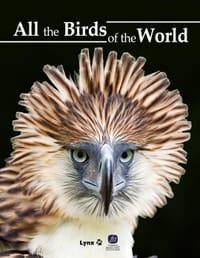
The easiest and most enjoyable way to browse through all the birds of the world and compare them.
For the first time ever, you can literally contemplate All the Birds of the World together in a single, easy-to-use, fully-illustrated volume. Created for a broad audience, from novice birders to expert ornithologists and anyone interested in the spectacular diversity of birds, this fascinating book has something for everyone to discover.
- Presents every taxon accepted as species by any of the four major world lists: 11,524 species in total.
- 20,865 illustrations covering sexual dimorphism, morphs and many distinctive subspecies.
- 11,558 distribution maps with altitudinal ranges included.
- All 3313 one-country endemic species marked.
- IUCN/BirdLife International conservation status given.
- Taxonomic treatment by the four major world lists indicated and compared.
- Nomenclatural discrepancies explained.
- All English and scientific names from eBird included.
- QR codes for instant access to videos, photos and sound recordings species-by-species.
- Checkboxes for personal record-keeping.
- All species known to have become extinct since the year 1500 presented separately in their own appendix.
- A 37-page world atlas of colour reference maps with all the details that interest birders and ornithologists.
- The easiest and most enjoyable way to browse through all the birds of the world and compare them.
[Review by Gehan de Silva Wijeyeratne – 1 Nov 2020]
Wow. All the Birds of the World in one book. How impossible this seemed when I first became a committed bird watcher as an early teen in the 1980s. Around this time, my parents gave me a copy of the fabulous ‘Birds of the World’ by Oliver L. Austin and Arthur Singer, an early introduction to the wonderful global diversity of birds. This really was more of a guide to the bird families of the world. A more recent and a superb version of this genre of book was also published by Lynx Edicions in 2015, ‘Bird Families of the World: An invitation to the Spectacular Diversity of Birds’ by David W. Winkler, Shawn M. Billerman and Irby J. Lovette. In 1986, when ‘Shorebirds: An Identification Guide to the Waders of the World’ by Peter Hayman, John Marchant and Tony Prater was published by Helm, for birders it seemed like an earth shattering moment. Over the subsequent three decades many wonderful family monographs have been published by a tiny handful of the world’s leading ornithological publishers. However, a single book which has all the bird species in the world was still nothing more than a daydream for birders. During the period from 1992 to 2013, the 17 volume Handbook of the Birds of the World (HBW) was published by Lynx Edicions. After a 21 year publishing marathon, a single publisher had published illustrations and descriptive text of all the birds in the world. HBW was a publishing milestone and a zoological milestone. Lynx Edicions is an unusual publisher. At the core, driving their efforts is a team of people who are field naturalists and scientists with a deep interest in taxonomy. But they have also channelled their work into a very efficient, commercially savvy and brilliantly administrated publishing business. One outcome of this is a database approach to mining the text and illustrations from one project, adding suitable updates and redeploying for future projects.
In 2014 and 2016, Lynx published the ‘HBW and Birdlife International Illustrated Checklist of the Birds of the World’, a superb two volume reference with every bird illustrated and distribution maps and succinct text. A book I keep dipping into as I need to periodically update the photographic guides I have written on birds. It is no surprise that this has been followed up with a single volume ‘All the Birds of the World’ (ABW). This is in the same standard large format of 310 x 240 mm of the HBW and the Handbook of the Mammals of the World (HMW). All the Birds of the World is also a door stopper of a book with 967 pages and weighing 4.8 kg. It is yet another publishing and zoological milestone. The fact that the first print run sold out so quickly says it all. Which person interested in birds would not want this book? There is something wondrous about holding a book in ones hands and knowing that it has every single bird species in the world; 11,524 taxons, 20,865 illustrations and 11,558 distribution maps. For a book of its size and importance, it was priced attractively in its initial offer. All of this for Euro 65 is an outstanding offering.
When I first opened this book, I must admit I was a little taken aback. It was different from every other bird book by the almost complete absence of text accompanying the illustrations. It looked more like a simple pictorial catalogue of birds with a lot of red circles b