
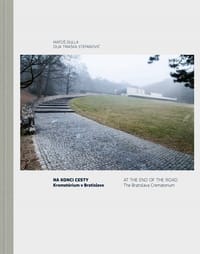
Crematorium Bratislava: At the End of the Road
出版时间
2018-01-01
ISBN
9788055629858
评分
沿着一条宽大的、阴郁的曲折人行道,就来到这座火葬场——由许多水平和垂直围墙构成的半临时性的围合空间。一间等候室面对着送葬者,从主入口上方高悬的墙板到葬礼教堂,充满了一种诀别的气氛。这是一座通向阴间的大门,送葬者一旦站在教堂内,就会感到情不自禁。火葬场建筑的构图原则十分明显:就像早期新造型派的风格,构件同时是物质的和抽象的。在教堂玻璃隔墙的另一边,有着一种理想的延续性,它强调着扩展的观念:扩展的空间成为了安息的空间。建筑从而完成着这种比拟。
离开教堂以后,送葬行列穿过这巨型玻璃隔墙,沿着一条更为狭窄的小路来到树林中的骨灰墓地。送葬行列不走回头路,这是一位斯堪的纳维亚建筑师(S. Lewerentz)在本世纪初经过调查以后发明的一条规则,他试图通过设计适当的送葬行列行进路线来象征生命的不断循环。火葬场教堂和骨灰墓地各自坐落在一条山谷的旁边,周围长满了茂密的树林,从而当送葬行列步行穿过开敞的墓园时,更强调着到达与离去的尺度。
—— Wilfried Wang
The publication is about the outstanding architectural masterpiece which is the crematorium in Bratislava, the capital of Slovakia. It was built a half of century ago (in 1968) under extremely favorable circumstances. Before that, there was a long battle that started back in 1889 to establish the institution of the crematory. The book presents the history of a modern cremation movement in Europe with the consideration of the long battle of Bratislava City to establish a crematorium, it focuses on international, but also local architectural stimulations, that influenced the architecture of the object. Besides the story of the building itself and the funeral garden, the public will find out about the creative work of the author of the building, architect Ferdinand Milucký, who was a member of the first Slovak postwar architectural generation. The texts of Matúš Dulla in English and Slovak are accompanied by the art photographs of Olja Triaška Stefanovic, that gently capture the changes of crematorium and it's surroundings during different seasons. The book is published on the 50th anniversary of the first Slovak crematory.
„A Ferdinand Milucký´s crematory in Bratislava-Lamac has been perfectly woven into the landscape. Today this ,Gesamtkunstwerk‘ that discreetly accompanies the path of the mourner is considered one of the icons of modernism in Slovakia.“ Benjamin Konrad and Maik Novotny (Austrian architects) „One of the most outstanding buildings of Slovakian post-war architecture is influenced by the ... Scandinavian clarity and open structure of design.“ Benjamin Konrad and Maik Novotny „The great cemetery (and crematory) of Bratislava, inspired by Scandinavian forest cemeteries, stands as one of the most important architectural contributions of Communist-era Eastern Europe.“ Pierre von Meiss, Swiss theoretist of architecture „one of the most important architectural contributions of Communist-era Eastern Europe“. Pierre von Meiss „Covered by a carpet of fallen, crumbling red leaves, the grounds of this winter forest of beech trees are not unlike those of any other beech forest in the world. Here, howewer, they are transformed into a distinct place thanks to the delicate insertion of this snaking bench hosting the urns of departed notables and punctuated by a rostrum awaiting one last homage to the deceased. In he background we can make out the plain, identical tombstones of the common people carefully following the curves of the terrain´s level.“ Pierre von Meiss „specific combination of totalitarian organization and artistic freedom indeed permitted architects to expand their limits and create an individual and conceptionally perfected body works“ Henrieta Moravcíková (Slovak theoretist of architecture) „It is not only a masterpiece of Slovak architecture but of Modernism as a whole.“ Wolfgang Jean Stock, German historian of sacral architecture
Prof. Ing. arch. Matúš Dulla, DrSc. was born in 1950 in Žilina, Slovakia. He is leading historian of the 20th century Slovak architecture. Dulla studied architecture at the Slovak technical university in Bratislava (1974) and received the degree of a professor (2000). He also worked at Slovak Academy of Sciences in Bratislava focusing on the history of architecture of the 20th ...