
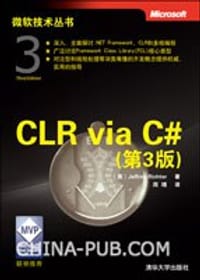
书籍介绍
这本书在读者口中反复被称作“net圣经”“进阶必看”,它的分量不在于教你怎么写代码,而在于让你“知其所以然”。翻开它,你会看到编译器如何把常量值嵌入IL、线程如何分配1MB栈空间、大对象为何直接落入第2代被回收——这些细节拼出的是一幅CLR内部运转的完整图景。读者最看重的,正是这种从“会用”到“懂机制”的跨越:当你能解释垃圾回收为何分代、为何避免深栈能加速回收时,编写高性能程序便不再是凭感觉。它适合那些不满足于调用API、渴望掌控运行时行为的C#开发者。唯一常见的抱怨是翻译生硬,这也提醒读者:配合原文对照阅读,方能真正吃透这块“金字招牌”的分量。
作者简介
Jeffrey Richter是一位在全球享有盛誉的技术作家,尤其在Windows/.NET领域有着杰出的贡献。他的第一本Windows著作Windows 3: A Developer's Guide大获好评,从而声名远扬。之后,他又推出了经典著作《Windows 高级编程指南》和《Windows核心编程》。如今这两本书早已成为Windows程序设计领域的颠峰之作,培育了几代软件开发设计人员。他的每一本新作问世,我们都有理由相信这是一本巨著,我们想要的一切尽在其中。Jeffery 是Wintellect公司的创始人之一,也是MSDN杂志.NET专栏的特邀编辑。
周靖 从1983年接触苹果机开始, “浸染”IT业数十年,涉猎广泛,具有深厚的技术功底和良好的文学素养。早期痴迷于硬件,曾担任《微型计算机》杂志特约作者多年。继而潜心钻研编程,并乐在其中积累了丰富的经验。其翻译风格严谨、准确、朴实、流畅,深受读者欢迎。代表译著有《c++面向对象程序设计》(Walter Savitch著)、 《Windows核心编程》 (Jeffrey Richter著)和《C++图形与游戏编程基础》 (Tony Gaddis著)等。业余时间,听音乐和看电影是他的爱好。
AI导读
核心看点
- 本书深入剖析CLR执行模型,涵盖从源代码编译、模块合并到程序集加载的全流程。详细解释IL验证、不安全代码处理及NGen.exe本地代码生成机制,帮助读者彻底理解.NET底层运行原理,掌握如何构建安全且高效的托管代码环境,是理解.NET基础设施的权威指南。
- 全面讲解类型设计与实现规范,包括强命名程序集、全局程序集缓存及版本管理策略。书中深入探讨元数据、资源嵌入及配置管理,指导开发者如何正确设计类型、处理互操作性问题,并防范程序集篡改,确保企业级应用的安全性与稳定性,符合公共语言规范要求。
- 重点解析线程处理与垃圾回收机制,揭示堆内存分配、对象分代回收及大对象堆的处理细节。通过深入分析栈空间分配、递归对GC的影响及IDisposable模式,教导读者如何优化内存使用、避免内存泄漏,并编写高性能、无死锁的多线程应用程序,提升系统整体性能。
读者共识
- 本书被公认为.NET领域的‘圣经’级著作,作者Jeffrey Richter是微软内部专家,其权威性无可置疑。尽管部分读者反映翻译质量参差不齐或内容过于晦涩,但普遍认可其技术深度和严谨性,认为它是C#程序员从中级迈向高级的必经之路,值得永久收藏。
- 读者普遍反映本书难度极高,阅读过程痛苦且耗时,甚至有人表示看完后很快遗忘。然而,这种‘痛苦’被视为成长的代价。多数资深开发者认为,即使无法完全记住所有细节,阅读过程本身也能极大提升对.NET底层机制的认知,改变编码思维,提升代码质量。
- 尽管存在版本老旧和翻译不佳的争议,但书中关于CLR原理、内存管理和并发编程的核心思想依然具有极高的参考价值。读者共识是,不应因翻译问题或版本差异而否定其价值,而应透过现象看本质,学习其严谨的设计理念和系统化的问题分析方法,这对任何语言开发者都有启发。
精彩摘录
- "代码引用一个常量时,编译器会在定义常量的程序集的元数据中查找该符号,提取常量的值,并将值嵌入生成的IL代码中。"
- "Different languages offer different capabilities.For example, in unmanaged C/C++, you have pretty low-level control of the system. You can manage memory exactly the way you want to, create threads easily if you need to, and so on. Microsoft Visual Basic 6.0, on the other hand, allows you to build UI"
- "The C# using directive instructs the compiler to try prepend-ing different prefixes to a type name until a match is found. The compiler will scan all of the referenced assemblies looking for the type’s definition. After the compiler finds the proper assembly, the assembly information and the type in"
- "The C# compiler, by default, automatically looks in the MSCorLib.dll assembly even if you don’t explicitly tell it to. The MSCorLib.dll assembly contains the definitions of all of the core Framework Class Library (FCL) types, such as Object, Int32, String, and so on."
- "When a thread is created, it is allocated a 1-MB stack. This stack space is used for passing arguments to a method and for local variables defined within a method. Stacks build from high-memory addresses to low-memory addresses. All but the simplest of methods contain some prologue code, which initi"
- "System.Object’s GetType method simply returns the address stored in the specified object's type object pointer member. In other words, the GetType method returns a pointer to an object’s type object, and this is how you can determine the true type of any object in the system (including type objects)"
- "Any data types the compiler directly supports are called primitive types. Primitive types map directly to types existing in the Framework Class Library (FCL)."
- "Even though unboxed value types don’t have a type object pointer, you can still call virtual methods (such as Equals, GetHashCode, or ToString) inherited or overridden by the type. If your value type overrides one of these virtual methods, then the CLR can invoke the method nonvirtually be- cause va"
目录
用户评论
c# clr 方面经典书籍
先有语言基础,才能谈得上设计模式等。用这本书去夯实语言基础!
刚发现买错版本了,已经有了第三版,内容没的说,作者就是一块金字招牌
啥也不说了。老婆的序写的很亮。。
讲得很完备,使用C#的必读
真的写的很精妙 读了两遍,写的很深入,用和知道其原理还是有区别的~
C#开发必须精读的好书
看完了前二十二章,这本厚书最后30%的内容暂时与我无缘
这本书真的必看。
五星好评,写c#的人必看
清华大学出版社的其他书籍查看全部





下载
收藏