
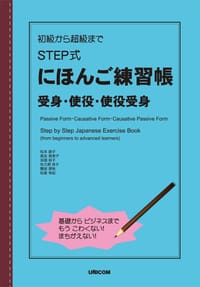
书籍介绍
<初級から超級までの、こんな方におすすめです>
*初級の日本語を勉強中で、「受身形」「使役形」「使役受身形」がわからない方。
*中級以上の日本語力があるが、「受身形」「使役形」「使役受身形」「自発形」の使い方がわからない方。
*上級以上の日本語力があるが、もう一度「受身形」「使役形」「使役受身形」「自発形」の復習がしたい方。
*他の日本語文法には自信があるが、「受身形」「使役形」「使役受身形」「自発形」に自信がない方。
*「受身形」「使役形」「使役受身形」「自発形」について、すべてを知りたい方。
*ニュアンスの違いを理解して、自然で誤解されない日本語を勉強したい方。
STEP 1 受身形
*日本語の受身文を、5つの種類に分けてわかりやすく説明してあるので、正しい受身文を理解して、自信を持って使うことができます。
*わかりやすい絵で、「受身形」の表現方法や、人間関係を理解することを学びます。
*例文や練習問題は、初級の人にでもわかるように、「わかちがき」で書いてあります。
*例文や練習問題は、初級で使う漢字だけを使いました。
STEP 2 使役形
*日本語の使役文を、3つの種類に分けてわかりやすく説明してあるので、正しい使役文を理解して、自信を持って使うことができます。
*絵を見て「強制の使役文」「放任・許容の使役文」「感情などに影響を与える使役文」の意味の違いを楽しく勉強することができます。
STEP 3 使役受身形
*日本語の使役受身文を、2つの種類に分けてわかりやすく説明してあるので、正しい使役受身文を理解して、自信を持って使うことができます。
<「コラム」で比較できます>
*コラム(column)では、間違えやすい、特に覚えておきたい「受身形」「使役形」「使役受身形」「自発形」を使った表現が説明してあります。
<豊富な練習問題があります>
*たくさんの種類の問題をしていくうちに自然に「受身形」「使役形」「使役受身形」の使い方・意味の違いを覚えることができます。
*ひとつひとつ手で書く形式が多いので、確実に「受身形」「使役形」「使役受身形」を覚えることができます。
<巻末に「動詞フォーム200」の表がありますから、「受身形」「使役形」「使役受身形」を覚えるのに便利です>
*200の動詞の表で、重要動詞の「受身形」「使役形」「使役受身形」が覚えられます。一度に覚えられなくても、全部覚えられるまで、何回も繰り返し練習することができます。
<全部の説明文・例文には、英語の翻訳が付いています>
*この本の英訳は、元の日本語がわかるように直訳してあるので、自然な英語ではありません。
*この本の「he」は「she、they」も表しています。
*英語に訳さない方がいい場合には、翻訳は付けてありません。
*For beginners who do not understand the Passive form, the Causative form, and the Causative Passive form.
*For students who have mid level and above Japanese ability but do not understand the usage of the Passive form, the Causative form, the Causative Passive form, and the Spontaneous form.
*For students with advanced or higher Japanese language abilities but who want to review the Passive form, the Causative form, the Causative Passive form, and the Spontaneous form.
*For students who are confident about other aspects of Japanese grammar but have no confidence regarding the Passive form, the Causative form, the Causative Passive form, and the Spontaneous form.
*For students who want to know all about the Passive form, the Causative form, the Causative Passive form, and the Spontaneous form.
*And for students who want to study how to speak natural Japanese without causing misunderstandings by truly understanding the differences in nuance.
STEP 1 Passive Form
*Five types of Japanese Passive sentences are explained in an easy to understand way, by understanding them you can use Passive sentences with confidence.
*You can learn expressions for the Passive form and understand the relationships between the people in a fun way by looking at easy to understand pictures.
*The example sentences and problems are written with spaces (“wakachigaki") so that even beginners can understand them.
*Only beginners level Kanji are used for the example sentences and problems.
STEP 2 Causative Form
*Three types of Japanese Causative sentences are explained in an easy to understand way, by understanding them you can use Causative sentences with confidence.
*You can enjoy studying by looking at pictures to see the difference in meaning between Compulsion Causative sentences, Non-interfering・Permission Causative sentences, and Emotion Influence Causative sentences.
STEP 3 Causative Passive Form
*Two types of Japanese Causative Passive sentences are explained in an easy to understand way, by understanding them you can use Causative Passive sentences with confidence.
*Explanations are given for expressions that use the Passive form, Causative form, Causative Passive form, or the Spontaneous form that are often mistaken or need particularly to be learnt.
*While you are doing the various problems you will naturally learn the usage of the Passive form, the Causative form, and the Causative Passive form and the difference in meaning.
*You will be able to properly learn the Passive form, the Causative form, and the Causative Passive form by the many problems that should be written out by hand.
*You can learn the important verb's Passive form, Causative form and Causative Passive form from the 200 verb list. You can practice these many times until you have learnt them all.
*The English is a direct translation in order to understand the Japanese and may not be natural English.
*Japanese sentences often do not include pronouns, so the word “he" is used for both “she" and “they."
用户评论
比较系统地整理了一些难点,配合老师整理的补充内容更佳。练习题也比较多,答案有简单解析。这是这一系列中做完的第一本。
日语的确是一门挺重感情的语言。线代汉语已经很偏向英文表达了。如果学日语不掌握授受关系的话,感觉是没有学到头的。(这方面我还很欠缺)
求书
收藏