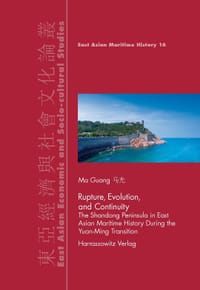
While previous scholars have paid much attention to the maritime history of Guangdong, Fujian, and Zhejiang in southern China, by contr ast, there are no monographs or articles focusing on maritime history of Shandong in northern China in Western scholarship. However, as a matter of fact, Shandong played a significant role in East Asian maritime history. This book attempts to break through the “Southeast China-centric” framework by focusing attention on the Shandong Peninsula during the Yuan-Ming transition (late thirteenth to early fifteenth centuries).
Many scholars have argued that there was rupture between the two dynasties in politics, society, and culture, or have argued the opposite from the perspective of land-centric history. By placing Shandong maritime history into a supra-regional, global historical context, the author’s study challenges the Southeast China centrism, the terra-centric model and various traditional views. Ma argues that on the one hand, there were obvious “ruptures” of maritime policy and maritime trade from the Yuan to the Ming dynasties, and on the other hand, some things, such as official sea transportation, continued from Yuan to Ming times. More importantly, although the function of the Shandong Peninsula changed from being primarily an important commercial entrepôt in the Yuan to being a crucial military base during Ming times, it is worth mentioning that it was a process extending over several decades, rather than a simple rupture.
官方购买页面(纸本+电子版):https://www.harrassowitz-verlag.de/title_6893.ahtml?T=1640763298
马光,比利时根特大学与奥地利萨尔茨堡大学历史学博士,山东大学历史文化学院教授、博士生导师,齐鲁青年学者,主要研究领域为元明东亚海洋史、近代社会经济史。已在《近代史研究》、《文史哲》、《清华大学学报》、《学术研究》、《江海学刊》、《南京大学学报》、Journal of Asian History、Crossroads等期刊上发表中英论文20余篇,多项成果被《新华文摘》、人大复印报刊资料、《高等学校文科学术文摘》等转载。曾获得国家社科基金、韩国高等教育财团、博士后特别资助、省社科规划等多个科研项目,获山东省社会科学优秀成果奖二等奖两次、三等奖一次,山东省高等学校人文社会科学优秀成果奖二等奖两次。