
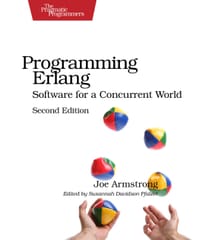
Programming Erlang, Second Edition
出版时间
2013-10-16
ISBN
9781937785536
评分
★★★★★
书籍介绍
这本书的独特之处,不在函数式语法本身,而在它彻底改变了你处理并行的思维方式。作者 Joe Armstrong 是 Erlang 语言的设计者,书中反复强调一个核心判断:世界本质是并行的,因此程序也该用并发结构来建模,而非用单一顺序流程去硬凑。读者反馈印证了这一点——真正让他们觉得
作者简介
Joe Armstrong is one of the creators of Erlang. He has a Ph.D. in computer science from the Royal Institute of Technology in Stockholm, Sweden and is an expert on the construction of fault-tolerant systems. He has worked in industry, as an entrepreneur, and as a researcher for more than 35 years.
AI导读
核心看点
- Erlang之父亲授,从基础到分布式全景解析
- 深入讲解消息传递并发模型与OTP框架实战
- 无需函数式基础,循序渐进掌握并行编程思维
读者共识
- 作为创始人著作,权威性强,适合系统入门
- 并发与分布式章节精彩,函数式部分略显枯燥
- 构建工具较原始,现代项目多转向Elixir生态
精彩摘录
- "The world is parallel. If we want to write programs that behave as other objects behave in the real world, then these programs will have a concurrent structure. Use a language that was designed for writing concurrent applications, and development becomes a lot easier. Erlang programs model how we th"
- "Functional programming forbids code with side effects. Side effects and concurrency don’t mix. You can have sequential code with side effects, or you can have code and concurrency that is free from side effects.You have to choose. There is no middle way."
- "Erlang is a language where concurrency belongs to the programming language and not the operating system."
- "A guard sequence is either a single guard or a series of guards, separated by semicolons (;). The guard sequence G1; G2; ...; Gn is true if at least one of the guards—G1, G2, ...—evaluates to true. A guard is a series of guard expressions, separated by commas (,). The guard GuardExpr1, GuardExpr2, ."
- "1. When we enter a receive statement, we start a timer (but only if an after section is present in the expression). 2. Take the first message in the mailbox and try to match it against Pattern1, Pattern2, and so on. If the match succeeds, the message is removed from the mailbox, and the expressions "
- "Download edemo2.erl 1> edemo2:start(false, abc). Process c received {'EXIT',<0.81.0>,abc} Process a received {'EXIT',<0.81.0>,abc} process b (<0.81.0>) is dead process c (<0.82.0>) is alive ok 2> edemo2:start(false, normal). process b (<0.85.0>) is alive process c (<0.86.0>) is alive ok 3> edemo2:st"
- "Note: When you read this code, you’ll see we just used a variable Pid everywhere. This is the process identifier of the linked process. We can’t use a variable name like LinkedPid to say this, because before we have evaluated link(Pid), it’s not a linked process. When you see a message like {’EXIT’,"
- "Step 1: Start an Erlang node on doris: doris $ erl -name gandalf -setcookie abc ([email protected]) 1> kvs:start(). true Step 2: Start an Erlang node on george, and send some commands to gandalf: george $ erl -name bilbo -setcookie abc ([email protected]) 1> rpc:call(ganda"
用户评论
感觉没有一个像mix这样的工具,build, release,还是感觉比较原始。所以最终还是去写elixir了。。。
快速扫了遍
非常适合有点基础的我入门,erlang 的消息传递式并发怎么看都觉得自然。
这本就好很多,毕竟是 Erlang 设计者写的。函数式部分所有都差不多那样没啥意思,并发和分布式部分有些意思。
作者讲的很全面。读了learn your an Erlang for great good后,还需要再读下这本才靠谱。
下载
收藏