
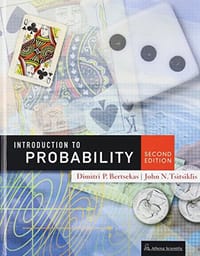
Introduction to Probability (2/e)
出版时间
2008-07-15
ISBN
9781886529236
评分
★★★★★
书籍介绍
An intuitive, yet precise introduction to probability theory, stochastic processes, and probabilistic models used in science, engineering, economics, and related fields. The 2nd edition is a substantial revision of the 1st edition, involving a reorganization of old material and the addition of new material. The length of the book has increased by about 25 percent. The main new feature of the 2nd edition is thorough introduction to Bayesian and classical statistics.
The book is the currently used textbook for "Probabilistic Systems Analysis," an introductory probability course at the Massachusetts Institute of Technology, attended by a large number of undergraduate and graduate students. The book covers the fundamentals of probability theory (probabilistic models, discrete and continuous random variables, multiple random variables, and limit theorems), which are typically part of a first course on the subject, as well as the fundamental concepts and methods of statistical inference, both Bayesian and classical. It also contains, a number of more advanced topics, from which an instructor can choose to match the goals of a particular course. These topics include transforms, sums of random variables, a fairly detailed introduction to Bernoulli, Poisson, and Markov processes.
The book strikes a balance between simplicity in exposition and sophistication in analytical reasoning. Some of the more mathematically rigorous analysis has been just intuitively explained in the text, but is developed in detail (at the level of advanced calculus) in the numerous solved theoretical problems.
Written by two professors of the Department of Electrical Engineering and Computer Science at the Massachusetts Institute of Technology, and members of the prestigious US National Academy of Engineering, the book has been widely adopted for classroom use in introductory probability courses within the USA and abroad.
From a Review of the 1st Edition:
...it trains the intuition to acquire probabilistic feeling. This book explains every single concept it enunciates. This is its main strength, deep explanation, and not just examples that happen to explain. Bertsekas and Tsitsiklis leave nothing to chance. The probability to misinterpret a concept or not understand it is just... zero. Numerous examples, figures, and end-of-chapter problems strengthen the understanding. Also of invaluable help is the book's web site, where solutions to the problems can be found-as well as much more information pertaining to probability, and also more problem sets. --Vladimir Botchev, Analog Dialogue
Several other reviews can be found in the listing of the first edition of this book. Contents, preface, and more info at publisher's website (Athena Scientific, athenasc com)
用户评论
最后两章分开讲述 Bayesian Inference 和 Classical Inference 一扫我对于Bayesian学派和Frequency 学派的各种不解
Best introduction to probability
今天想了很久的期望,在此记录想法。
1.期望=∑p*value,这是加权平均数,权重即p,value出现的概率。考虑极端的情况:一个学生考试59分的概率是99%,90分的概率是1%,那么考试得分期望其实就基本等同于只看这个59分(计算可得期望为59.31分)。
2.关于p*value联想到了赌马:瘦弱的马一旦赢了奖金很高,可是赢的概率很小;强壮的马赢的概率大,可是奖金不高。
3.实际应用中,更重要的是根据具体的情境去设计、转化,这个过程正如数学建模,会存在信息丢失。首先问自己:是期望什么东西越高越好?
4.在一众的选择中我们要选期望高的。期望意味着随机、预测,随机意味着真实结果可能高于或低于期望,但是无妨,我们还是要选期望高的,它就像拥有高平均分的快班,即便我们清楚快班最后一名不如慢班第一。
对计算机很实用,是静态的那种概率。但对准备测度论或金融概率没用,那要求的math maturity是数学系的路子
以前没系统学过,会把random variable(X)和scalar(x)搞混。现在好了。
讲得清楚,还有ocw视频辅助,毫无疑问是最好的初等概率论课程。相对Sheldon Ross的书几乎一年出一个edition,这本内容组织精炼、稳定,也是非常适合做工具书参考的。
肝过
MIT OCW,大爱。