
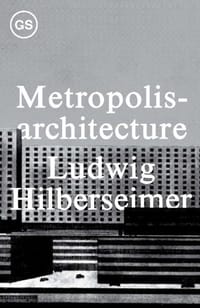
Metropolisarchitecture
出版时间
2014-03-08
ISBN
9781883584757
评分
★★★★★
书籍介绍
In the 1920s, the urban theory of Ludwig Hilberseimer (1885–1967) redefined architecture's relationship to the city. His proposal for a high-rise city, where leisure, labor, and circulation would be vertically integrated, both frightened his contemporaries and offered a trenchant critique of the dynamics of the capitalist metropolis. Hilberseimer's Großstadtarchitektur is presented here for the first time in an English translation. Its propositions encourage us to reconsider mobility, concentration, and the scale of architectural intervention in our own era of urban expansion.
作者简介
Ludwig Hilberseimer (1885–1967) was a planner, architect, critic, and educator. During the 1920s, he developed theoretical projects for the city that remain influential today.
Richard Anderson is lecturer in architectural history at the University of Edinburgh. With Kristin Romberg, he is the author of Architecture in Print: Design and Debate in the Soviet Union, 1919–1935.
精彩摘录
- "For Tafuri, the allegedly utopian dimension of architecture had the specific role of making emerging cycles of urban restructuring culturally and socially acceptable. For example, Tafuri described the trend of picturesque landscaping as promoting the ideology of an allegedly "natural city" in the fa"
- "While the contradictions and asymmetries of the capitalist city have only intensified, the majority of architects have indulged in a narrowing of their concerns that restricts design to the scale of the architectural object and leaves the city unconsidered. Commercial pressure on offices leaves litt"
- "But the most problematic aspect of research on the contemporary city is the total disconnection between, on the one hand, an understanding of architecture in relationship to urban form and, on the other, an understanding of architecture in relationship to political economy."
用户评论
这年头除了Caruso之外,最能圈钱的应该就是Aureli了。不过他的文章还是不错的,虽然看多了就会发现有些观点不能苟同,比如他说Rossi和Hilberseimer的共同点之一是两人都视城市为最重要的,建筑为城市服务。嗯,Rossi明明就更关心纪念物啊,说城市只为找理由
要复习
The city as not an object, but cycles, forces, processes. Connect the understanding of architecture in relation to urban forms, and political, economic, social concerns.
下载
收藏