
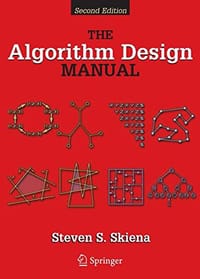
书籍介绍
这不本适合从头学算法的书,而是一本给已经懂算法的人'用'算法的手册。读完CLRS的人仍会在这里找到收获——因为它不纠缠于证明的严密,而是聚焦实战:如何为100条与500万条数据分别选型、如何让快排在实践中真正跑得快、如何系统地寻找反例。读者反复提到它'总能说到点子上',计算几何、组合优化等内容也远超入门范畴。正因习题不多、语言简练,它更适合带着明确目标的人:面试前快速复习、工作中需要权威参考、或想看看'真思考、不装逼'的算法写作是什么样子。如果你已经走过算法的入门阶段,这本手册会是你案头真正被翻旧的那本。
作者简介
Steven Skiena (1961-, http://www.cs.sunysb.edu/~skiena/) is a Professor of Computer Science in State University of New York at Stony Brook
AI导读
核心看点
- 作者获IEEE教学奖,内容直观易懂
- 侧重实用算法设计与工程实现细节
- 包含大量面试真题与解题策略指导
读者共识
- 面试刷题利器,讲解生动不装逼
- 不适合初学者,但胜在实用接地气
- 动态规划与回溯章节评价极高
精彩摘录
- "Typical computer science students study the basic sorting algorithms at least three times before they graduate: first in introductory programming, then in data structures, and finally in their algorithms course."
- "When you have morethan 100 items to sort, it is important to use an O(nlgn)-time algorithm like heapsort, quicksort, or mergesort. ... Once you get past (say) 5,000,000 items, it is important to start thinking about external-memory sorting algorithms that minimize disk access."
- "If you are determined to implement your own quicksort, use the following heuristics, which make a big difference in practice: * Use ranomization * Median of three * Leave small subarrays for insertion sort * Do the smaller partition first"
用户评论
这是一本中级算法书,之前没有编程基础看此书很可能会觉得没讲明白。
特点正如标题所示是手册:简短的语言总结和比较了种种算法与数据结构。无怪Steve Yegge推荐给程序员面试前复习算法用。学习算法不建议用这本,而应该选择更详细全面的CLRS或者Kleinberg&Tardos
当年找工作看得这个,非常赞 习题做的不多 内容简洁清晰
Solves the question of whether having sex with someone is unidirectional or not.
相见恨晚
不适合入门,当工具书很不错的!
重在实践。不适合作为第一本算法书 但或许可以是最后一本。
可以一直看下去。。。
假装看完了
看了很长时间,非常好。
Springer的其他书籍查看全部
 200 Years of Friedrich Engels
 Deepfakes
 Statistical Foundations, Reasoning and Inference: For Science and Data Science
 Introduction to Linear and Matrix Algebra
 Studien zur Struktur des Bewusstseins
 nternet of Things (IoT)
下载
收藏