
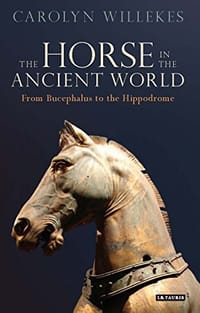
As this book demonstrates, horses and humans have had a long and complicated relationship. Indeed, the introduction foregrounds the interdependence of humans and horses. While horses have aided many human endeavors including communication and trade, humans have also enabled domestic equids to flourish as a species. Rather than a study concerning the interactions of humans and horses, this book emphasizes the horse itself and focuses on the development and characteristics of the animal throughout the ancient world. Willekes’ approach is to examine the conformation of the horse and the effect this conformation had on the function and use of each type of horse in the ancient world. Often, the horse is treated as a homogeneous animal, unchanging across time and space. This book shows how the horse adapted to different environments and how these adaptations were used by the ancient peoples of these regions.
“Methodology” outlines the focus on the work, which, through an analysis of artistic, literary, and archaeological evidence, seeks to “establish a typology for the horses of the ancient world”. Willekes prefers the term “type” to the more familiar “breed” as specialized breeding occurred infrequently in antiquity. Horse types developed from adaptation to the environment, rather than artificial selection by humans.
Willekes begins the book by examining the evolution and behavioral characteristics of the horse. The horse is a prey animal with a strong flight response. As Willekes demonstrates, an understanding of these characteristics elucidates the behaviors of horses in ancient literature. The unusual, aggressive behavior of Alexander the Great’s famous horse Bucephalus is more understandable when we view this aggression as a response to fear (of his shadow) and inability to flee this fear. The natural equine response is to flee from danger and so aggression must be trained in a horse. The rest of the chapter describes the ideal horse from literature. Five Greek and Roman authors supply a description of the ideal horse: Xenophon, Varro, Virgil, Oppian, and Columella. Willekes notes that these descriptions are strikingly similar. At this point, it would have been useful to discuss whether the later authors were influenced by Xenophon or another author like Simon of Athens, whose work is mentioned in Xenophon. This portion of the book is the most useful for a classical and, in particular, philological audience. Scholars working on the aforementioned authors may find it useful to compare those works to Willekes’ explication and discussion of the parts of the horse. The author includes details from her experience as an equestrian, which aid in clarifying the passages of literature.
Chapter Three, “Prehistoric Horses” is less useful for the non-specialist. Here, Willekes discusses previous classifications of early or “ancestral” equines, from which domestic horses developed. Among the various classification hypotheses, Willekes settles on four main types, which resulted from adaptation to environmental conditions: the Northern European pony, the Northern Steppe horse, the Southern Steppe horse, and the Iberian/Mediterranean horse. She then discusses each ancestral type through case studies of modern horse breeds (Exmoor pony, Przewalski’s Horse, Akhal Teke, and Asturian and Sorraia). She comprehensively discusses the conformation, history, and physical characteristics of each modern breed and connection to its ancestral equivalent. This chapter needs a conclusion, especially to emphasize the development of these modern breeds from the ancestral types. One wonders, for example, what intermediary steps there were between the ancestral horse type and the modern breed.
The next chapter, “The Ancient Horse Types,” describes horse types from several regions of the world (Central Asian Horse, Near Eastern Horse, Mediterranean Horse). However, no introduction makes clear the relationship between the ancestral types and these regional “ancient horse types.” Are these “ancient types” an intermediate step between the ancestral types and modern equine breeds? Here, the author discusses the environment, lifestyle conditions, and appearance of each horse type and, in doing so, clearly explains ancient practices for non-equestrians. For example, the author considers the practice of castration of Scythian and Sarmatian horses, as cited by Strabo. She cites supporting archaeological evidence and then discusses this practice from the view of animal husbandry. These horses were kept in large herds on the grassland, so castration made the herd more manageable. Willekes’ experience conducting experimental archaeology is very helpful in this regard. Her understanding of modern practices enables her to explicate ancient ones. She continues each section with a discussion of the appearance of the ancient horse type by body part (head, shoulder, hindquarters, etc.). This section seems to be based