
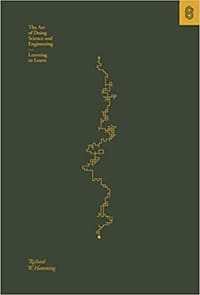
The Art of Doing Science and Engineering
出版社
出版时间
2020-05-26
ISBN
9781732265172
评分
★★★★★
书籍介绍
这不是一本教你'如何发论文'的方法论手册,而是一位从洛斯阿拉莫斯实验室走出来的工程师,对'什么是好的思考'这件事的长篇告白。Hamming 的核心主张近乎冒犯:卓越不是天赋,而是一种可以训练出来的思维方式——你会主动收集数据、把问题推到极限、让直觉建立在对数量级的感觉之上。书中反复出现的'back of the envelope calculation'(信封背面的估算)、对'只看书而不看自然'的学院派的警惕、对 ambiguity(模糊性)的拥抱,构成了一套鲜明甚至偏执的工程气质。它扎实、理性、不鸡汤,却也让习惯标准答案的读者感到'读不太懂'。真正适合的是愿意把学科底层 idea 打通、并对'思考本身'有执念的人——它更像一面镜子,照出你与'伟大工作'之间的距离。
作者简介
Richard W. Hamming was a scientist and mathematician whose work inspired a generation of engineers, scientists, and researchers. He is best known for discovering mathematical formulas that allow computers to correct their own errors, a fundamental function of modems, compact disks, and satellite communications.
Born in Chicago in 1915, he provided crucial programming support as a member of the Manhattan Project. After World War II, he joined Bell Labs, where over the next 15 years he was involved in nearly all of its most prominent achievements. He later taught and lectured at the Naval Postgraduate School in Monterey, California. Throughout his career, Hamming received many awards for his work, including the Turing Award in 1968, the highest honor in computer science. In 1988, the Institute of Electrical and Electronics Engineers created the Richard W. Hamming Medal in his honor, of which he was the first recipient. He died in 1998.
精彩摘录
- "But you were all taught about the evils of the Middle Age scholasticism-people deciding what would happen b reading in the books of Aristotle(384-322 BC)rather than looking at nature. This was Galileos(1564-1642)great point which started the modern scientific revolution--look at nature not in books!"
用户评论
So many insights and interesting ideas!
style is art;
teacher should prepare their students for their future, not themselves past;
未来不可知,而过去其实也不可知,因此预测未来没什么特别的;
Education is what, when, and why to do things, Training is how to do it;
technology: science + enginnering;
The purpose of computing is insight, not numbers;
这书实在是太棒了,需要打印出来看纸质版,不能只是看电子版;
not a fan

下载
收藏