
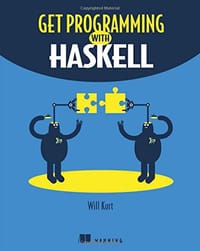
Get Programming with Haskell leads you through short lessons, examples, and exercises designed to make Haskell your own. It has crystal-clear illustrations and guided practice. You will write and test dozens of interesting programs and dive into custom Haskell modules. You will gain a new perspective on programming plus the practical ability to use Haskell in the everyday world. (The 80 IQ points: not guaranteed.)
Will Kurt currently works as a Data Scientist at Quick Sprout. With a formal background in both Computer Science (MS) and English Literature (BA) he is fascinated with explaining complex technical topics as clearly and generally as possible. He has taught a course section on Haskell at the University of Nevada, Reno and given workshops on Functional Programming. He also blogs a...
- 本书采用短小精悍的课时结构,通过清晰的图解和引导式练习,帮助读者从零开始掌握Haskell。内容涵盖函数式编程基础、递归规则、模式匹配及高阶函数,强调通过编写和测试大量有趣程序来内化知识,而非枯燥的理论堆砌,确保读者获得实际编程能力。
- 深入讲解类型系统核心概念,包括自定义类型、类型类以及半群与幺半群等代数结构。书中特别注重解释Functor、Applicative和Monad的协同工作机制,阐明其如何支持代码中‘快乐路径’的打包能力,帮助读者理解这些抽象概念在错误处理和上下文操作中的实际价值。
- 作者结合Python等命令式语言进行对比分析,揭示变量声明、状态变更与函数式编程范式的本质差异。通过具体案例展示如何利用Haskell特性优雅处理缺失值,避免繁琐的空值检查和异常处理,让读者获得全新的编程视角,提升代码安全性与简洁性。
- 适合希望系统学习函数式编程思想的开发者,特别是那些对Haskell感兴趣但被传统教材晦涩理论劝退的初学者。本书循序渐进的教学风格适合需要清晰引导、重视实践操作的读者,帮助其跨越从命令式编程到函数式编程的思维鸿沟,建立正确的编程范式认知。
- 适合有一定编程基础,想要拓展技术视野,理解类型系统、代数结构在软件工程中的应用的程序员。书中对类型类、组合设计模式的深入讲解,有助于读者提升代码抽象能力和设计水平,即使不从事Haskell开发,也能从中获得关于软件架构和函数式设计的宝贵启示。
- 适合对计算机科学基础理论感兴趣,希望深入理解递归、闭包、部分应用等概念底层逻辑的学生或研究者。本书严谨的数学基础与工程实践相结合,适合那些追求代码正确性、安全性,并愿意投入时间钻研复杂抽象概念,以提升解决复杂问题能力的读者。
- 请务必动手完成书中的所有练习和示例代码。Haskell的学习高度依赖实践,仅阅读文字无法真正掌握其思维模式。书中提供的错误案例和调试过程极具价值,通过亲自复现并解决这些问题,才能深刻理解类型系统报错背后的逻辑,避免陷入概念混淆的困境。
- 不要试图一次性理解所有抽象概念。书中涉及的Monad、Functor等概念较为晦涩,若感到困惑,请回顾前文关于函数组合和错误处理的铺垫。作者强调这些概念是为了简化代码而非增加复杂度,请始终从‘如何更安全地处理数据’的角度去理解,而非死记硬背定义。
- 注意区分书中提到的语言扩展功能与标准Haskell语法。书中涉及的部分高级特性可能需要配置GHC编译器选项,初学者应优先掌握核心语法和标准库用法。若遇到编译错误或环境配置问题,可参考官方文档或社区资源,切勿因环境搭建问题阻碍学习进度。
- 读者普遍认为这是目前最好的Haskell入门教程之一,评价其讲解清晰、循序渐进,尤其对Functor/Applicative/Monad等难点的解释透彻且实用。相比其他充满幽默但逻辑混乱的教材,本书严谨的教学风格和高质量的练习设计获得了广泛认可,被赞为‘提出问题-引入工具-解决问题’的典范。
- 尽管部分读者指出书中某些概念过渡不够平滑,不适合完全零基础的新手,但大多数反馈认为其知识屏蔽做得很好,避免了不必要的理论干扰。读者赞赏作者对类型系统见解独到,通过对比其他语言帮助理解差异,认为其提供的编程视角转变价值远超语言本身,适合有经验的开发者转型。
- 社区反馈显示,本书在提升代码安全性和简化错误处理方面效果显著,读者无需担心空指针异常即可编写健壮程序。虽然学习曲线依然陡峭,但读者一致认为其带来的思维提升和工程实践价值巨大,强烈推荐给希望深入理解函数式编程原理并应用于实际项目的开发者,不建议浅尝辄止。
本导读基于书籍简介、目录、原文摘录、短评和书评生成,不等同于全文精读。
- "In most programming languages, variables are declared before they’re used. This convention in most programming languages is partially the byproduct of being able to change state. Variable order matters because you can always reassign the value of something after you’ve assigned it. In Haskell, becau"
- "Listing 8.3 myCycle myCycle (first:rest) = first:myCycle (rest++[first]) Even with our rules as a guide, often recursion can cause quite a headache..."
- "Q19.2 Write a version of map that works for Maybe types, called maybeMap."
- "maybeMap :: (a -> b) -> Maybe a -> Maybe b maybeMap func Nothing = Nothing maybeMap func (Just val) = Just (func val)"
- "There are two ways to use a language extension. The first is by using it when compiling with GHC. To do this, use the flag -X followed by the extension name. For a program named text.hs, this looks like the following: $ ghc text.hs -XOverloadedStrings This can also be used as an argument to GHCi, to"
- "Functor’s <$> provides a common interface to apply any function to a value in a context. ... For IO, it’s essential to be able to change values in an IO context, because you can’t take IO values out of their context."
- "You just wrote a pro- gram that handles missing values well, but not once did you have to check whether a value was null using conditionals, or worry about exception handling. Even better, you could write the core functionality of your program, haversine, as though nothing in the world might go wron"
- "Listing 34.12 Your Main.hs file that uses your Palindrome.hs file"
显示全部
 Deep Learning with Python (2/e)
 Functional Design and Architecture
 Grokking Machine Learning
 Unit Testing
 Deep Learning with JavaScript
 Istio in Action