
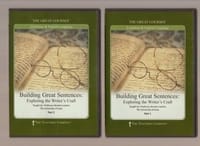
Building Great Sentences (Audiobook) - Professor Brooks Landon

Building Great Sentences (Audiobook)

Professor Brooks Landon

出版时间

2008-01-01

ISBN

9781598034479

评分

★★★★★
书籍介绍

Great writing begins—and ends—with the sentence.

Whether two words ("Jesus wept.") or 1,287 words (a sentence in William Faulkner's Absalom! Absalom!), sentences have the power to captivate, entertain, motivate, educate, and, most importantly, delight.

Understanding the variety of ways to construct sentences, from the smallest clause to the longest sentence, is important to enhancing your appreciation of great writing and potentially improving your own.

* Why do some lengthy sentences flow effortlessly while others stumble along?

* Why are you captivated by the writing of particular authors but not others?

* How can you craft sentences that reflect your own unique outlook on the world?

Get the answers to these and other questions about writing and style in Building Great Sentences: Exploring the Writer's Craft, a lively 24-lecture course taught by Professor Brooks Landon from the University of Iowa—one of the nation's top writing schools. You explore the myriad ways in which we think about, talk about, and write sentences. You discover insights into what makes for pleasurable reading. You also learn how you can apply these methods to your own writing.

More Than Just a String of Words

Building Great Sentences revives the sentence-oriented approach to studying writing. Unlike common nuts-and-bolts approaches to discussing writing, this course provides a greater context for what makes sentences great. You investigate how to recognize the mechanics of the sentences you read and write, you learn how language works on your thoughts and emotions, and you discover basic strategies to sharpen your ability to recognize great sentences and make your own everyday writing more effective.

More than just a string of words, "sentences are shaped by specific context and driven by specific purpose," notes Professor Landon. "No 'rules' or mechanical protocols can prepare us for the infinite number of tasks our sentences must accomplish."

Explore a Vast World of Sentences

Consisting of a subject, a verb, and sometimes an object ("The girl raised the flag."), the kernels from which sentences grow are called minimal base clauses. Adding modifying words ("slowly") or phrases ("because doing so would inspire her compatriots") creates larger sentences that lead toward great writing.

In Building Great Sentences, you delve into the ways that literary and popular writers work with these larger sentences (called cumulative sentences) and encounter the three distinct levels that enhance these sentence kernels by:

* Adding information and keeping a sentence moving in place ("She served the dessert, a French pastry affair dripping in dark chocolate.")

* Moving a sentence forward with increased specificity ("He drove carefully, one hand on the wheel, the other hand holding a sandwich, a ham and cheese fossil, a strangely colored lump made days before by his sister.")

* Adding information and moving a sentence forward at the same time ("Big Al headed back into the bar, a demented grin twisting his scarred face, his bloodshot eyes narrowed to a fierce squint, looking around the dim and smoke-filled interior, scanning the terrified inhabitants for any of his tormentors.")

You also explore sentence constructions that make writing more complex and add exciting levels of suspense, and you see tactics that create balance and rhythm in sentences. Professor Landon makes these writing methods clear and easy to apply to your own reading and writing habits. Some of the many illuminating methods you come across are:

* Using a mirroring effect between words to suggest confidence ("Dryden's page is a natural field, rising into inequalities, and diversified by the varied exuberance of abundant vegetation; Pope's is a velvet lawn, shaven by the scythe, and leveled by the roller.")

* Using three phrases of parallel construction to create unity and emphasis in a sentence ("I came, I saw, I conquered.")

* Beginning each element in a series with the same word or words ("The reason I object to Dr. Johnson's style is that there is no discrimination, no selection, no variety in it.")

* Ending each element in a series with the same word or words ("Raphael paints wisdom; Handel sings it, Phidias carves it, Shakespeare writes it, Wren builds it, Columbus sails it, Luther preaches it, Washington arms it, Watt mechanizes it.")

Recognizing and appreciating these and other eye-opening aspects of sentences helps you understand the work that goes into creating an effective, pleasurable sentence. With the newfound knowledge gained from Building Great Sentences, you become more aware of why particular lines, passages, or phrases in the poems, novels, or articles you read so enchant you.

Learn from the Masters

Building Great Sentences draws abund

目录
Course Lecture Titles
1.A Sequence of Words
2.Grammar and Rhetoric
3.Propositions and Meaning
4.How Sentences Grow

显示全部
用户评论
这是TTC的课程,我看了一部分。作者提倡写长句,而且提倡用分词形式(作者称为modifier)来作修饰。但个人感觉这种写法仅限于文学作品,对议论文和科技论文写作帮助不大,甚至可能是backfire,因为我感觉我的托福作文正是因为用了这里提倡的句式而中枪了-_-。
Building是导读性课程,所有评判需要基于此。其意义在于让写句子的人知道句子在独立与内容之外还有自己的结构,以及这种结构在久经磨炼后所沾染上的附属意义和效果。这些意义和效果,只有当你自己在实际使用过程中碰到问题,回头看时,才看的清楚,给予重视,心领神会。作为导读性课程,通过文学中的实际使用,让人在文学欣赏的积极情绪中知道syntax这门细致、本身较为枯燥的学问,Build很好的完成了TTC的宗旨。其目标完成度近乎5星。 大概三年前看的视频,但当时无法理解。现在自己在写句子,忽然能理解了。至于有人说不适合科学写作,需要这么说,没有什么句式不适合,关键在于物尽其用。科学写作中的诸多长句,恰恰用cumulative syntax更能清晰且简介的表达。见到的少,可能是由于写论文的人自身限制。
让我对句子的写作与欣赏产生了新的认识,不论是中文还是英文。 唯一有一点就是,与其说是一门课不如说是像本有声书,例子念的太多了,整体节奏拖沓。
3-19-2013,看不出所以然,只是提纲
…哎
光看文本的话比较像文献综述,如果是课程讲义的话,比较像阅读理解,所以必须先阅读作者在书中提到的那些作家的作品才能比较了解他讲的概念,而且讲得也不细致,只是大概梳理,对于写作没有太大用处。
收藏