
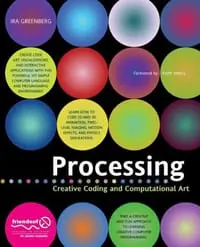
Processing: Creative Coding and Computational Art
出版社
出版时间
2008-02-25
ISBN
9781590596173
文件格式
评分
★★★★★
内容简介
Create code art, visualizations, and interactive applications with this powerful yet simple computer language and programming environment
Learn how to code 2D and 3D animation, pixel-level imaging, motion effects, and physics simulations
Take a creative and fun approach to learning creative computer programming If you're interested in creating cutting-edge code-based art and animations, you've come to the right place! Processing (available at www.processing.org) is a revolutionary open source programming language and environment designed to bridge the gap between programming and art, allowing non-programmers to learn programming fundamentals as easily as possible, and empowering anyone to produce beautiful creations using math patterns. With the software freely available, Processing provides an accessible alternative to using Flash for creative coding and computational artboth on and off the Web. This book is written especially for artists, designers, and other creative professionals and students exploring code art, graphics programming, and computational aesthetics. The book provides a solid and comprehensive foundation in programming, including object-oriented principles, and introduces you to the easy-to-grasp Processing language, so no previous coding experience is necessary. The book then goes through using Processing to code lines, curves, shapes, and motion, continuing to the point where you'll have mastered Processing and can really start to unleash your creativity with realistic physics, interactivity, and 3D! In the final chapter, you'll even learn how to extend your Processing skills by working directly with the powerful Java programming languagethe language Processing itself is built with.
You'll learn:
The fundamentals of creative computer programming—from procedural programming, to object-oriented programming, to pure Java programming
How to virtually draw, paint, and sculpt using computer code and clearly explained mathematical concepts
2D and 3D programming techniques, motion design, and cool graphics effects
How to code your own pixel-level imaging effects, such as image contrast, color saturation, custom gradients and more
Advanced animation techniques, including realistic physics and artificial life simulation
Summary of Contents
PART ONE: THEORY OF PROCESSING AND COMPUTATIONAL ART
Chapter 1: Code Art
Chapter 2: Creative Coding
Chapter 3: Code Grammar 101
Chapter 4: Computer Graphics, the Fun, Easy Way
Chapter 5: The Processing Environment
PART TWO: PUTTING THEORY INTO PRACTICE
Chapter 6: Lines
Chapter 7: Curves
Chapter 8: Object-Oriented Programming
Chapter 9: Shapes
Chapter 10: Color and Imaging
Chapter 11: Motion
Chapter 12: Interactivity
Chapter 13: 3D
Chapter 14: 3D Rendering in Java Mode
PART THREE: REFERENCE
Appendix A: Processing Language API
Appendix B: Math Reference
Appendix C: Integrating Processing within Java
作者简介
About the Author
With an eclectic background combining elements of painting and programming, Ira Greenberg has been a painter, 2D and 3D animator, print designer, web and interactive designer/developer, programmer, art director, creative director, managing director, art professor, and now author. He holds a BFA from Cornell University and an MFA from the University of Pennsylvania.
Ira has steadily exhibited his work, consulted within industry, and lectured widely throughout his career. He was affiliated with the Flywheel Gallery in Piermont, New York, and the Bowery Gallery in New York City. He was a managing director and creative director for H2O Associates in New York\'s Silicon Alley, where he helped build a new media division during the golden days of the dot-com boom and then bust—barely parachuting back to safety in the ivory tower. Since then, he has been inciting students to create inspirational new media art; lecturing; and holding residencies at numerous institutions, including Seton Hall University; Monmouth University; University of California, Santa Barbara; Kutztown University; Moravian College; Northampton Community College\'s Digital Art Institute; Lafayette College; Lehigh University; the Art Institute of Seattle; Studio Art Centers International (in Florence, Italy); and the City and Guilds of London Art School.
Currently, Ira is Associate Professor at Miami University (Ohio), where he has a joint appointment within the School of Fine Arts and Interactive Media Studies program. He is also an affiliate member of the Department of Computer Science and Systems Analysis. His research interests include aesthetics and computation, expressive programming, emergent forms, net-based art, artificial intelligence, physical computing, and computer art pedagogy (and anything else that tickles his fancy). During the last few years, he has been torturing defenseless art students with trigonometry, algorithms, and object-oriented programming, and is excited to spread this passion to the rest of the world.
Ira lives in charming Oxford, Ohio with his wife, Robin; his son, Ian; his daughter, Sophie; their squirrel-obsessed dog, Heidi; and their night prowler cat, Moonshadow.
AI 导读
编辑书评
- 这本书是创意编程领域的‘考古层’,虽因版本陈旧而失去即时实用性,却保留了独特的思维范式。它的真正价值不在于教你写出可运行的现代代码,而在于展示如何用极简逻辑驾驭复杂视觉。对于想跳出传统软件工程思维、进入生成艺术领域的创作者,它提供了一种‘反直觉’的入门视角:先追求美感,再修补语法。但若你急需就业技能,请果断转向Python或JavaScript教程,勿在此浪费生命。
- 编辑认为本书处于尴尬的中间地带:既不够严谨以作为大学教材,又不够新颖以吸引当代开发者。其优势在于对‘交互’与‘运动’概念的早期系统化梳理,这在当时极具前瞻性。如今重读,更像是在审视一种设计哲学的起源。适合在周末午后,配合模拟器或旧版IDE,作为一种智力休闲而非严肃学习来阅读。它提醒我们,技术的终极目的往往是解放创造力,而非束缚于规范。
核心看点
- 本书核心在于利用Processing语言搭建编程与艺术的桥梁,强调通过代码实现2D/3D动画、像素级图像处理及物理模拟。它并非传统计算机科学教材,而是面向设计师和艺术家的创意编码指南,旨在让非程序员也能通过数学模式创作视觉作品,重点在于‘创造性’而非底层算法效率。
- 书中Motion(运动)、Interactivity(交互)和Visualization(可视化)章节被读者反复提及为精华所在。这些部分展示了如何将静态图像转化为动态体验,以及如何处理用户输入以产生实时反馈。对于新媒体艺术从业者而言,这部分内容提供了从概念到落地的具体技术路径,是区别于纯理论书籍的实战价值所在。
- 作为一本基于Processing 1.0版本的老书,其独特价值在于保留了早期创意编程社区的探索精神。尽管语法已过时,但其关于图形渲染逻辑、色彩空间应用以及基础交互设计思维的讲解依然具有启发性。它证明了在特定历史阶段,简化编程复杂度以释放创造力这一理念的成功实践。
读者共识
- 读者普遍认可其‘风趣文笔’与‘丰富实例’的结合,认为相比枯燥的技术手册,本书更具可读性和趣味性。然而,也有声音指出其例子质量参差不齐,部分读者认为同类竞品《Getting Started with Processing》在案例设计上更为精炼有效。
- 关于适用性的争议集中在‘是否适合计算机入门’。多数评论达成共识:它绝非正统编程语言教程,强行用于CS基础教学会导致体验糟糕。但对于专注于图像设计和新媒体艺术的群体,它被视为‘初级必备’的入门读物,能迅速建立信心。
- 版本过时是最大痛点。大量短评抱怨买到的是旧版(1.0),导致学习成本增加。尽管如此,仍有资深读者肯定其中Motion和3D章节的价值,认为只要克服语法转换障碍,其核心设计理念依然不过时,值得投入时间研读。
读者评论
有例子,文笔风趣。
虽然是1.0版本,但是motion一章很有用
其实到后面谈Visualization的部分还是蛮有趣的,果然还是主攻图像设计类的语言,根本不能算作正统语言系列,拿它做计算机入门太无聊了。怒端上一碗热热的Python. Chris 2013.12.13
motion , interactivity , 3D
我太蠢了!!!难怪打0.9折,这尼玛是processing 1.0啊!!
其实到后面谈Visualization的部分还是蛮有趣的,果然还是主攻图像设计类的语言,根本不能算作正统语言系列,拿它做计算机入门太无聊了。怒端上一碗热热的Python.
Apress的其他书籍查看全部
 《Programming with 64-Bit ARM Assembly Language》
 《Practical Rust Projects》
 《Game Development with Ren'Py》
 《Practical Shader Development》
 《Pro .NET Memory Management》
 《Beginning PowerApps》