
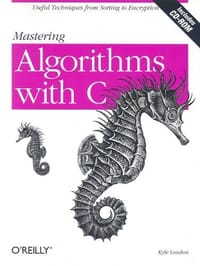
Mastering Algorithms with C
出版社
出版时间
1999-08-05
ISBN
9781565924536
评分
★★★★★
书籍介绍
This book offers robust solutions for everyday programming tasks, providing all the necessary information to
understand and use common programming techniques. It includes implementations and real-world examples of
each data structure in the text and full source code on the accompanying website
(http://examples.oreilly.com/masteralgoc/). Intended for anyone with a basic understanding of the C language.
Preface
When I first thought about writing this book, I immediately thought of O'Reilly & Associates to publish it. They were the first publisher
I contacted, and the one I most wanted to work with because of their tradition of books covering "just the facts." This approach is not
what one normally thinks of in connection with books on data structures and algorithms. When one studies data structures and
algorithms, normally there is a fair amount of time spent on proving their correctness rigorously. Consequently, many books on this
subject have an academic feel about them, and real details such as implementation and application are left to be resolved
elsewhere. This book covers how and why certain data structures and algorithms work, real applications that use them (including
many examples), and their implementation. Mathematical rigor appears only to the extent necessary in explanations.
Naturally, I was very happy that O'Reilly & Associates saw value in a book that covered this aspect of the subject. This preface
contains some of the reasons I think you will find this book valuable as well. It also covers certain aspects of the code in the book,
defines a few conventions, and gratefully acknowledges the people who played a part in the book's creation.
Bookmarks
Main Page
Table of content
Copyright
Preface
Organization
Key Features
About the Code
Conventions
How to Contact Us
Acknowledgments
Part I: Preliminaries
Chapter 1. Introduction
1.1 An Introduction to Data Structures
1.2 An Introduction to Algorithms
1.3 A Bit About Software Engineering
1.4 How to Use This Book
Chapter 2. Pointer Manipulation
2.1 Pointer Fundamentals
2.2 Storage Allocation
2.3 Aggregates and Pointer Arithmetic
2.4 Pointers as Parameters to Functions
2.5 Generic Pointers and Casts
2.6 Function Pointers
2.7 Questions and Answers
2.8 Related Topics
Chapter 3. Recursion
3.1 Basic Recursion
3.2 Tail Recursion
3.3 Questions and Answers
3.4 Related Topics
Chapter 4. Analysis of Algorithms
4.1 Worst-Case Analysis
4.2 O-Notation
4.3 Computational Complexity
4.4 Analysis Example: Insertion Sort
4.5 Questions and Answers
4.6 Related Topics
Part II: Data Structures
Chapter 5. Linked Lists
5.1 Description of Linked Lists
5.2 Interface for Linked Lists
5.3 Implementation and Analysis of Linked Lists
5.4 Linked List Example: Frame Management
5.5 Description of Doubly-Linked Lists
5.6 Interface for Doubly-Linked Lists
5.7 Implementation and Analysis of Doubly Linked Lists
5.8 Description of Circular Lists
5.9 Interface for Circular Lists
5.10 Implementation and Analysis of Circular Lists
5.11 Circular List Example: Second-Chance Page Replacement
5.12 Questions and Answers
5.13 Related Topics
Chapter 6. Stacks and Queues
6.1 Description of Stacks
6.2 Interface for Stacks
6.3 Implementation and Analysis of Stacks
6.4 Description of Queues
6.5 Interface for Queues
6.6 Implementation and Analysis of Queues
6.7 Queue Example: Event Handling
6.8 Questions and Answers
6.9 Related Topics
Chapter 7. Sets
7.1 Description of Sets
7.2 Interface for Sets
7.3 Implementation and Analysis of Sets
7.4 Set Example: Set Covering
7.5 Questions and Answers
7.6 Related Topics
Chapter 8. Hash Tables
8.1 Description of Chained Hash Tables
8.2 Interface for Chained Hash Tables
8.3 Implementation and Analysis of Chained Hash Tables
8.4 Chained Hash Table Example: Symbol Tables
8.5 Description of Open-Addressed Hash Tables
8.6 Interface for Open-Addressed Hash Tables
8.7 Implementation and Analysisof Open Addressed Hash Tables
8.8 Questions and Answers
8.9 Related Topics
Chapter 9. Trees
9.1 Description of Binary Trees
9.2 Interface for Binary Trees
9.3 Implementation and Analysis of Binary Trees
9.4 Binary Tree Example: Expression Processing
9.5 Description of Binary Search Trees
9.6 Interface for Binary Search Trees
9.7 Implementation and Analysis of Binary Search Trees
9.8 Questions and Answers
9.9 Related Topics
Chapter 10. Heaps and Priority Queues
10.1 Description of Heaps
10.2 Interface for Heaps
10.3 Implementation and Analysis of Heaps
10.4 Description of Priority Queues
10.5 Interface for Priority Queues
10.6 Implementation and Analysis of Priority Queues
10.7 Priority Queue Example: Parcel Sorting
10.8 Questions and Answers
10.9 Related Topics
Chapter 11. Graphs
11.1 Description of Graphs
11.2 Interface for Graphs
11.3 Implementation and Analysis of Graphs
11.4 Graph Example: Counting Network Hops
11.5 Graph Example: Topological Sorting
11.6 Questions and Answers
11.7 Related Topics
Part III: Algorithms
Chapter 12. Sorting and Searching
12.1 Description of Inserti
用户评论
副作用是教你如何写C语言程序,尤其是建立C语言库
同上,实际工作总算法用得少学习进度就停滞了
讲解浅入浅出,适合简单了解。优点是附代码让人有动手欲望。
跟着书的第二部分把Data structure写了一遍。这本书看上去很厚,实际上很大一部分都是代码,而且文字很多一部分都是重复的,所以真正的内容不是很多。
优点:
1. 有C语言代码实例,并且作者在很多平台上测试过,代码是没有问题的
缺点:
1. 数据结构部分都是用linked list来做的,所有有些操作的效率还是比较低的;
2. 语言不是很容易理解,读起来有点吃力(可能是我英语太差了)
O'Reilly的其他书籍查看全部

下载
收藏