
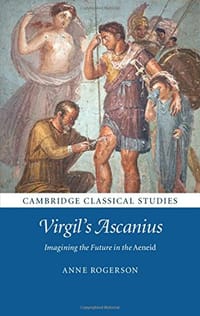
This fine and stimulating book discusses multivalent and slippery prophecies, significant names and their etymologies, and especially the importance of variant and inconsistent versions of myth. To quote Julie Andrews in The Sound of Music, “these are a few of my favorite things.” But even someone whose interests do not overlap with this book’s as thoroughly as mine will find much of value here.
The book, originally a dissertation supervised by Philip Hardie and Emily Gowers, has ten concise chapters including the introduction and conclusion. Different chapters explore conflicting statements about whether the Trojan Ascanius or Aeneas and Creusa’s half-Italian son Silvius Postumus will be heir to Aeneas and ancestor of the Alban Kings, Romulus, and the Julians; the significance of the names Ilus, Iulus, and Ascanius; the ways that “Ascanius is appropriated as a symbol” (p. 57) by female characters, both Dido and especially the backwards-looking and Troy-fixated Andromache in Aeneid 3; how the strong and problematic associations of Ascanius with Troy are stressed by Andromache, by Ascanius’ performing of the “Trojan Games,” and in other passages; how the omen of Ascanius’ flaming head in Aeneid 2 could be read in different ways, and how the similar omen in Book 7 furthers the idea that Lavinia’s line and that of Ascanius are to be in competition; how Ascanius is portrayed at times as an exotic and even “erotic, un-epic presence” (p. 138) who needs special protection, and at other times as an immature, rash boy lacking in self-control; and how these various worrisome qualities, and his persistent Trojanness, suggest that he might make a less suitable heir and ancestor than Silvius. Rogerson’s close reading of the details of the text, which builds both on context and on the poet’s precise word-choice, calls attention to many aspects of the poem that we have missed. The book offers a thoroughly modern way of reading: Rogerson is well-versed in the mythological background and makes solid philological arguments, but shares the modern scholar’s openness to ambiguity and uncertainty––when the details of the text support such a reading. Not every reader will agree with everything she says, but the arguments are careful and compelling.
Describing how the Aeneid often evokes potential future conflict between Ascanius and his family on the one hand and Lavinia and her son Silvius Postumus on the other is central to the book’s novel contribution, so I’ll give that question the most attention here. After a thoughtful Introduction, Rogerson begins in Chapter 2 with a review of Aeneas’ offspring in earlier versions of the story, many of which depict multiple sons or even daughters, and often feature conflict between Ascanius’ and Lavinia’s lines. These versions, including Livy’s recent declaration of aporia in Ab Urbe Condita 1.3.2-3, formed the context in which readers would have received Vergil’s new story. Of course a new poet is free to innovate, and to declare, e.g., that Aeolus is in need of a wife in Aeneid 1, rather than the married father of twelve of Odyssey 10. But Rogerson shows again and again that the poet’s careful word-choice points to rather than evades the problem of Aeneas’ heirs. She shows first that in numerous passages divine or divinely inspired figures state or imply that Ascanius will found Alba Longa and that his heirs will reign both at Alba and at Rome. These passages include Jupiter’s words to Venus in 1.267-74 and to Mercury in 4.234 (repeated by Mercury in 274-76, and cited by Aeneas in 355), Anchises' in 6 (the Parade of Heroes features Caesar et omnis Iuli / progenies magnum caeli uentura sub axem, 789-90), the description of Aeneas’ shield (genus omne futurae / stirpis ab Ascanio, 8.628-29), and Apollo’s addressing Ascanius as dis genite et geniture deos (9.642). But the problem is that Anchises also says that Aeneas’ half-Italian son Silvius Postumus will be “king and father of kings”: Siluius, Albanum nomen, tua postuma proles, / quem tibi longaeuo serum Lauinia coniunx / educet siluis regem regumque parentem, 763-65. The phrasing regem regumque parentem even resembles and points to Book 9’s dis genite et geniture deos. Silvius’ Alban nomen “becomes the cognomen of all the Alban kings hereafter ([Livy] 1.3.7), down to Numitor, father of Rhea Silvia, the mother of Romulus and Remus” (p. 19). Rogerson nicely notes that when Anchises introduces the Parade by speaking of “what glory is to come for Aeneas’ Dardanian offspring” (Dardaniam prolem … 6.756), Dardanius is not a bland adjective meaning “Trojan,” but evokes “Dardanus’ dual nature as both Trojan and Italian” (p. 28) and the “hybrid” nature he shares with Silvius Postumus, who is pointedly described as Italo commixtus sanguine (762).
When in Book 7 the flaming-head omen that marked Ascanius as special in Book 2 recurs in connection with Lavinia, “The repetition … casts Lavinia as the Ascanius figure fo
 Networks of Faith and Profit
 Parfit's Ethics
 Negotiating Mughal Law
 The History of the Arthaśāstra
 A History of the Roman Equestrian Order
 Jurist in Context